The Complete Guide to Cat Ear Care: Anatomy, Warning Signs, and How to Clean Your Cat's Ears Safely
4 weeks ago
There's a particular moment that most cat owners have experienced at least once, and it's not a pleasant one. You're giving your cat a routine scratch behind the ears — something they normally lean into with the focused satisfaction of a creature who has decided this is the best thing happening anywhere on earth right now — and you notice something off. A dark discharge. An unusual smell. Your cat flinching away from a touch that's usually welcome, or shaking their head in a way that looks less like a casual ear-flick and more like genuine, persistent irritation.
By the time you can see and smell the signs of an ear problem, the problem has usually been building for a while. Cat ear infections, mite infestations, and fungal growth don't announce themselves suddenly — they accumulate in the warm, dark, narrow interior of the ear canal, quietly progressing past the point of easy resolution while the cat does what cats instinctively do with discomfort: hide it until they can't anymore.
This guide exists to keep you well ahead of that scenario. We're going to go through the full picture: the anatomy of a cat's ear and why it's structurally prone to certain problems, how to recognize the difference between a healthy ear and one heading toward trouble, how to clean your cat's ears safely at home as a regular preventive practice, what the warning signs of serious infection look like, and how all of this fits into a broader approach to keeping your cat healthy and comfortable for the long run.
It's more ground than it might seem at first — cat ear care is genuinely a topic where understanding the underlying biology makes the practical advice make sense, rather than just being a list of steps to follow blindly. And understanding it properly might genuinely save your cat from a great deal of preventable discomfort.
Let's start where everything starts: with the anatomy.
Understanding What You're Working With
Why Cat Ears Are Remarkable — And Why That Makes Them Vulnerable
Before we get into cleaning techniques and warning signs, it's worth spending real time with the biology of a cat's auditory system, because it directly explains both why ear care matters so much and why certain problems are structurally likely without adequate preventive attention.
A cat's hearing is, by any reasonable measure, extraordinary. The feline auditory system is capable of detecting frequencies that span a far wider range than human hearing — extending both lower into the bass frequencies and significantly higher into ultrasonic territory that sits entirely beyond what human ears can perceive. This high-frequency capability is directly relevant to their ancestral hunting role: the ultrasonic vocalizations of small rodents, completely inaudible to human ears, fall squarely within a cat's auditory range. A cat hunting in a field is detecting sounds that exist, to us, in total silence.
Beyond frequency range, the physical architecture of a cat's outer ear — specifically the large, mobile, triangular pinna that we think of as the visible ear flap — gives cats a directional precision that exceeds our own. Those independently mobile pinnae, which can rotate and angle toward a sound source independently of each other and independently of where the cat's head is pointing, function as biological parabolic reflectors, gathering sound waves from a specific direction and concentrating them toward the ear canal. A cat can identify the precise location of a sound source with accuracy that humans simply cannot match, and can track a moving sound source continuously without moving their head.
All of this remarkable capability depends on the physical integrity of the auditory system. Damage to any component — outer, middle, or inner ear — degrades the system in ways that meaningfully affect the cat's quality of life, their ability to navigate their environment, their awareness of approaching threats or opportunities, and in the case of inner ear damage, their physical balance and coordination. Keeping the ear system healthy isn't cosmetic maintenance. It's essential care for one of the cat's most important sensory systems.
The Three-Part Structure of the Feline Ear
A cat's ear, like all mammalian ears, is divided into three functionally distinct sections. Understanding each one separately helps explain both what you're doing during an ear cleaning and why the distinction between outer, middle, and inner ear problems matters so much clinically.
The outer ear is everything you can see and access without specialized equipment — the pinna (ear flap) and the ear canal itself, from the canal opening down to the eardrum. The pinna's triangular, upright shape in most cat breeds maximizes its sound-gathering ability, and the muscles that control its movement give it that characteristic rotational mobility. The ear canal in cats runs downward and then slightly inward at an angle — a funnel-shaped pathway that leads sound waves to the eardrum.
That funnel shape is elegant for acoustic purposes but creates a specific structural vulnerability. Because the canal narrows and angles inward, material that enters it — dirt, wax, moisture, debris from the environment — doesn't drain or exit easily. It tends to accumulate, particularly at the bend in the canal, creating exactly the conditions that favor the growth of bacteria, yeast, and mold: warmth, darkness, moisture, and organic material. This is why the outer ear canal is the primary site for the vast majority of feline ear problems. It's not bad luck — it's anatomy.
The middle ear sits on the far side of the eardrum — the tympanic membrane — from the outer ear. It's a small, air-filled cavity containing three tiny bones, the ossicles, whose job is to amplify and transmit the mechanical vibrations produced by the eardrum when sound waves reach it. The middle ear also includes the Eustachian tube, a narrow passageway connecting to the throat that helps equalize pressure on both sides of the eardrum.
Under normal circumstances, the eardrum acts as a barrier between the outer and middle ear, preventing material from the canal from reaching the more sensitive inner structures. But when outer ear infections become severe and untreated, that barrier can be compromised — through direct damage from deep bacterial infection, through the pressure of accumulated material pressing against it, or through traumatic rupture from aggressive or inappropriate cleaning attempts. When infection reaches the middle ear, the clinical situation becomes significantly more serious and requires professional veterinary management.
The inner ear is the deepest and most complex section, and the most critical. It houses two distinct functional systems that operate simultaneously within the same anatomical structure. The cochlea — a fluid-filled, spiral-shaped chamber sometimes described as resembling a snail shell — is responsible for converting mechanical sound vibrations into the electrical nerve signals the brain interprets as hearing. Damage to the cochlear structures produces hearing loss.
The vestibular system, housed in channels adjacent to the cochlea and also filled with specialized fluid, is responsible for something entirely different: balance and spatial orientation. The fluid in these channels shifts in response to the cat's head movements, and specialized sensory cells detect those shifts to provide the brain with real-time information about the body's position and motion. This is the system responsible for the cat's legendary balancing ability — the automatic righting reflex, the ability to land on their feet, the capacity to walk narrow surfaces and make precise spatial judgments. Inner ear infections or damage disrupt this system, causing a characteristic clinical picture that includes head tilting, loss of balance, circling behavior, and disorientation that can be genuinely alarming to witness in a cat who normally moves with effortless grace.
What a Healthy Cat Ear Looks Like — And What Doesn't
Building a Baseline Through Regular Observation
One of the most valuable things you can do as a cat owner is simply to look at your cat's ears regularly enough to know what normal looks like for your specific cat. Ear appearance varies somewhat between individuals — ear pigmentation, the amount of hair inside the pinnae, baseline wax production — and establishing a personal baseline makes early deviation from that baseline much easier to detect.
This doesn't require dedicated sessions. Folding a quick ear check into your regular grooming interactions — the same petting and brushing sessions you're doing anyway — takes seconds per ear and provides the ongoing observational data that makes early detection possible.
What Healthy Ears Look Like
A healthy cat ear has a consistent, recognizable set of characteristics.
The skin on the inner surface of the pinna — the side facing inward when the ear flap is in its natural upright position — should have a clean, smooth appearance with a pinkish-white coloration. Some cats have naturally more pigmented inner pinnae, particularly in darker-coated breeds, and this is normal, but the tissue should look uniform and healthy rather than inflamed or discolored relative to the surrounding skin.
The canal opening, visible when you gently fold the pinna back to expose it, should be clear and free of visible accumulation. A small amount of pale, light tan wax is entirely normal — ears self-clean to some degree through the natural migration of material outward — but the canal should not be visibly packed with dark, crumbly, or wet material.
Healthy ears have no odor. This is one of the most reliable and most practically useful indicators of ear health, and it takes only a second to check during handling. A healthy ear, sniffed closely, smells of nothing in particular — perhaps a faint warmth, but no distinct smell. Any recognizable, specific odor emanating from the ear canal is a meaningful deviation from normal that warrants attention.
Normal cat behavior relative to the ears is essentially non-behavior: the ears move naturally in response to sounds, but the cat doesn't touch them. No scratching at the ears or the side of the head with the rear paws. No rubbing the head against furniture or carpet in a way targeted at the ear region. No repeated head shaking that continues well beyond a single casual ear-flick.
Warning Signs That Something Is Wrong
Deviation from the healthy baseline can manifest in several ways, and recognizing these warning signs early gives you the best possible window for intervention before a problem progresses to something more serious.
Dark or abnormal discharge is perhaps the most obvious visual warning sign. Healthy ears produce a small amount of light-colored wax. Dark brown, black, or crumbly discharge — sometimes described as having the appearance of coffee grounds — is classically associated with ear mite infestation, which is one of the most common feline ear conditions, particularly in younger cats and those with outdoor access or exposure to other cats. Green discharge indicates active bacterial infection. Any of these colors, especially in significant quantity, warrants a veterinary visit rather than a home-cleaning attempt, because cleaning without knowing the underlying cause can sometimes make conditions worse rather than better.
Redness, swelling, or inflammation of the inner pinna skin or the visible portions of the canal indicates that the tissue is responding to irritation, infection, or inflammation. Mild, transient redness after vigorous scratching is not necessarily alarming on its own, but redness that persists between grooming sessions, or redness accompanied by other signs, should be evaluated professionally.
Foul odor is a reliable indicator of active infection. Bacterial and yeast overgrowth produce distinct odors that are hard to miss once you know what to look for — a musty, yeasty smell suggests fungal involvement, while a sharper, more unpleasant smell typically accompanies bacterial infection. Either is a clear signal to schedule a veterinary visit.
Persistent scratching and head-shaking deserve particular mention because they're often the first behavioral changes owners notice, before any visible changes in the ear's appearance. Cats scratch at their ears and shake their heads in response to discomfort, itching, or the sensation of foreign material in the canal. Occasional ear-flicking or brief scratching is normal. Repeated, persistent scratching — particularly with the rear claws targeting the area around the ear — or head shaking that happens frequently throughout the day is not normal and indicates something is causing ongoing discomfort that needs investigation.
An important caveat about these signs: the microscopic organisms responsible for many of the most common feline ear conditions — ear mites, certain bacteria, fungal spores — are completely invisible to the naked eye. A cat with a significant ear mite infestation can have an ear that looks relatively unremarkable at a casual glance, because the mites themselves aren't visible and the early discharge they produce can be subtle. Persistent behavioral signs — the scratching and head-shaking — are therefore often more reliable early indicators than visual inspection alone, and they should be taken seriously even when the ear looks relatively normal.
Common Ear Problems to Know
Ear Mites: The Most Common Culprit
Ear mites — specifically Otodectes cynotis, a tiny arachnid related to ticks and spiders — are among the most prevalent feline ear conditions, particularly in kittens, cats with outdoor exposure, and cats living with other animals who might carry mites. They're highly contagious between cats and can spread to dogs in the same household.
Mites live on the surface of the ear canal, feeding on skin debris and ear secretions. Their presence causes intense itching — the mites' movements and waste products create a persistent irritation — and prompts the ear to produce increased wax and discharge as a defensive response. This discharge is characteristically dark brown to black and crumbly, often compared in appearance to coffee grounds. The combination of intense itching and the visual discharge is the classic presentation.
Mites are not dangerous in the sense of being life-threatening in healthy adult cats, but they are a significant source of discomfort and they don't resolve without treatment. Untreated mite infestations can persist for months, causing ongoing irritation and eventually secondary bacterial or yeast infections as the canal's normal environment is disrupted by the chronic inflammation the mites produce. Diagnosis is confirmed by a veterinarian through microscopic examination of the discharge, and treatment typically involves medicated ear drops or spot-on parasite treatments.
Bacterial Ear Infections
Bacterial otitis — ear infections caused by bacterial overgrowth — typically occur when the normal environment of the ear canal is disrupted in a way that allows opportunistic bacteria to proliferate. This disruption can come from prolonged moisture in the canal (common in cats who dislike being dried after bathing), from the tissue damage and altered microenvironment that mite infestations or foreign bodies create, or in cats with anatomically narrow or hairy ear canals that trap material more readily than others.
The discharge associated with bacterial infection tends to be wet, yellowish, or green — the color coming from the inflammatory response and bacterial waste products. The odor is typically sharp and unpleasant. The surrounding tissue is usually visibly inflamed and sensitive to touch.
Bacterial infections require veterinary diagnosis to determine the specific organism involved (different bacteria respond to different antibiotics) and appropriate antibiotic treatment, either topical, systemic, or both depending on severity. They should not be managed with home cleaning alone, both because cleaning won't eliminate the bacterial population and because the inflamed tissue is vulnerable to additional damage from cleaning-related trauma.
Yeast and Fungal Infections
Yeast overgrowth — most commonly involving Malassezia species, which are normally present on cat skin in small, harmless numbers — becomes a clinical problem when conditions in the ear canal shift in ways that favor their proliferation. Warmth, moisture, and altered skin chemistry from other underlying conditions can all tip the balance from normal yeast presence to overgrowth.
Yeast ear infections typically produce a brown, waxy discharge with a characteristic musty or fermented odor that's quite distinct from bacterial infection smell once you've encountered both. The itching and discomfort they cause is comparable to bacterial infections, and scratching-related trauma can introduce secondary bacterial infection, creating a mixed presentation.
Antifungal treatment is required, either topical antifungal ear drops or systemic treatment for more extensive infections. Recurrent yeast ear infections sometimes signal an underlying condition — allergies, immune dysfunction, hormonal issues — that the recurrent infections are symptomatic of, and addressing the underlying cause rather than just treating each episode individually is important for long-term resolution.
How to Clean Your Cat's Ears Safely at Home
Before You Start: The Right Mindset
Home ear cleaning is an important part of preventive ear care — routine cleaning removes the accumulating wax, debris, and moisture that create favorable conditions for infection and helps you notice changes in the ear's appearance before they become problems. But it's important to approach it with the right understanding of what you're actually doing.
Home cleaning is maintenance and prevention, not treatment. If your cat's ear has visible signs of infection — significant dark discharge, redness, swelling, foul odor — cleaning is not the appropriate response. Those signs indicate a condition that needs professional diagnosis and treatment, and cleaning an infected ear, particularly an ear where the eardrum may be compromised, can push infected material deeper and cause additional harm. The cleaning techniques in this section are for routine maintenance of ears that appear healthy, not for managing ears that are already showing signs of trouble.
With that important caveat clearly established, let's go through the proper approach.
What You'll Need
Cotton pads or rounds are the appropriate cleaning material for the areas accessible during home ear cleaning — the inner surface of the pinna and the visible upper portion of the ear canal. Cotton rounds, widely available at any pharmacy, are ideal: they're soft, they have enough surface area to be effective without being unwieldy, and they're gentle enough on the delicate tissue of the ear's inner surface.
Never use cotton swabs (Q-tips) inside the ear canal. This deserves emphasis because it runs counter to what many people intuitively reach for. Cotton swabs are designed for an ear anatomy — the human outer ear canal — that runs fairly straight and doesn't narrow significantly. A cat's ear canal angles and narrows in a way that makes cotton swab insertion genuinely dangerous. The swab can contact the eardrum before you realize you've gone deep enough to reach it. It can push accumulated debris further into the canal rather than removing it. And the very act of pushing something down a narrow canal can cause the canal walls themselves to sustain damage. Cotton swabs belong in the bathroom for human use, not in the cat care toolkit.
A veterinarian-recommended ear cleaning solution is the appropriate cleaning fluid for home ear maintenance. The reason a vet-recommended formulation matters is that ear cleaning solutions are not all equivalent — their pH, their ingredient profiles, and their specific formulations affect how they interact with the delicate tissue of the ear canal. Solutions designed for humans, generic cleaning agents, hydrogen peroxide, and alcohol-based solutions are all inappropriate for feline ear canals and can cause irritation, dryness, or damage to the canal lining. Before beginning a routine cleaning practice, ask your veterinarian to recommend a specific product appropriate for your cat's ear type and health history.
A well-lit area might seem obvious, but it makes a genuine practical difference. The inner surface of the pinna and the canal opening are not dramatically illuminated in typical room lighting, and being able to see clearly what you're doing — and what you're seeing — is both practically important for effective cleaning and essential for the observational purpose of regular ear checks.
Preparing Your Cat
The practical challenge of cat ear cleaning isn't usually the cleaning technique itself — it's getting the cat to hold still, relaxed, and cooperative for the duration. Most cats find ear handling at least slightly unusual and some resist it actively, and trying to perform ear care on a stressed, struggling cat increases the risk of accidental trauma to the ear and to you.
The single most effective preparation is timing. A cat that has just woken from a long nap, is in the post-meal relaxation phase, or is already engaged in a comfortable petting session is in a physiologically and psychologically different state from an alert, active, or wary cat, and that difference is directly relevant to how they'll tolerate ear handling. Wait for a genuinely calm moment rather than initiating ear cleaning when you need to do it regardless of the cat's state.
Begin with general petting — the sides of the face, the cheeks, the base of the neck, areas your cat already associates with positive touch. Work gradually toward the ears, incorporating gentle massage around the base of each ear before touching the ear flap itself. This progression from familiar, welcome touch toward the specific touch you need gives the cat time to remain relaxed rather than suddenly tensing at unexpected contact with an area they're not used to having handled.
If your cat has never had their ears handled regularly, the first few attempts should be brief and non-demanding — just folding the ear back gently, holding it for a moment, and releasing it, followed by positive reinforcement (a small treat or continued affectionate attention). Building positive associations with ear handling over multiple low-stakes sessions before attempting a full cleaning makes the actual cleaning sessions considerably smoother.
The Cleaning Process
Once your cat is genuinely relaxed and positioned comfortably — either in your lap or on a stable surface where you can support their head — you can proceed with cleaning.
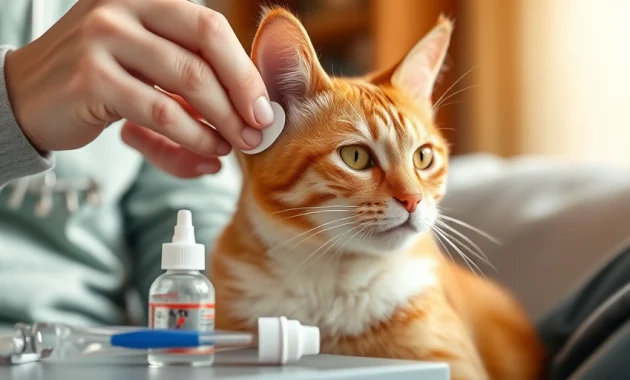
Step one: Expose the canal. Gently grasp the ear flap (pinna) between your thumb and forefinger and fold it back away from the head. This exposes the canal opening and the inner surface of the pinna more fully to your view. The fold should be gentle — enough to expose the canal without pulling in a way that creates tension or discomfort.
Step two: Apply the cleaning solution. Following your veterinarian's specific instructions for the product you're using, apply the appropriate number of drops of cleaning solution into the canal opening. The solution is designed to reach into the canal and loosen accumulated wax and debris. There's usually a moment here where the cat reacts to the sensation of fluid entering the ear — this is expected, and gently holding the ear flap down for a few seconds while the solution settles helps keep it in position.
Step three: Massage the ear base. Without releasing the pinna, use your other hand to gently massage the cartilaginous base of the ear from the outside — the area just below where the ear meets the skull. You'll typically hear a squelching sound as the cleaning fluid works through the accumulated material in the lower canal. This gentle massage helps break up and loosen wax and debris that the fluid has penetrated. Ten to fifteen seconds of gentle massage is usually sufficient.
Step four: Allow the shake. Now release the ear and step back slightly, because your cat will almost certainly shake their head vigorously — and should be allowed to. The head-shake is a natural, beneficial response that helps move the loosened material from the deeper portions of the canal toward the opening where it can be removed. Let the shake happen rather than trying to hold the cat still through it.
Step five: Wipe clean. With a clean cotton pad wrapped around your fingertip, gently wipe the inner surface of the pinna and the visible upper portion of the canal opening. Work from inside outward — from the canal area toward the outer edge of the pinna — so that you're drawing material out of the ear rather than pushing it further in. Use a fresh cotton pad when the first becomes soiled rather than reintroducing material you've just removed. Wipe only what you can see comfortably without inserting your finger or any instrument into the canal.
Step six: Repeat on the other ear. Always use a fresh cotton pad for the second ear — reusing the same pad between ears risks transferring any organisms or debris from one side to the other.
Step seven: Positive reinforcement. Finish the session with whatever form of positive reinforcement your cat values most — a treat, play, prolonged petting. The association between ear cleaning and something positive that follows accelerates the process of the cat becoming tolerant and eventually genuinely cooperative with routine ear care.
How Often to Clean
For most cats with healthy ears, a weekly check combined with cleaning as needed — meaning when the check reveals visible accumulation — is the appropriate baseline frequency. Some cats, particularly those with narrower ear canals, hairier pinnae, or histories of ear problems, may benefit from cleaning every few days. Some cats with naturally very clean ears may need formal cleaning less than once a week.
The weekly check is the non-negotiable part. The cleaning itself is guided by what the check reveals. A cat whose ear shows minimal accumulation during a weekly check doesn't necessarily need cleaning that week — unnecessary cleaning can actually disrupt the ear's normal environment and microflora in ways that are counterproductive. The goal is to maintain health, not to achieve a standard of cleanliness that the ear's own mechanisms don't require external help to maintain.
When Home Care Isn't Enough — Knowing When to See a Vet
The Limitations of What You Can Observe and Treat at Home
The most important thing to internalize about home ear care is the boundary of what it's designed to accomplish. Routine cleaning removes surface-level accumulation, provides regular observational data, and maintains the canal environment in a state less favorable to microbial overgrowth. It does not treat infections, eliminate mite infestations, reach the deeper portions of the ear canal, or manage conditions affecting the middle or inner ear.
Any of the following warrant a veterinary visit rather than — or in addition to — home cleaning:
Persistent behavioral signs including frequent scratching at the ears, repeated head-shaking, rubbing the head against surfaces, or apparent sensitivity when the ear area is touched. These signs indicate discomfort that exceeds what routine maintenance can address.
Significant visible discharge, particularly discharge that is dark, colored, wet, or present in quantity beyond a small amount of light wax. The coffee-ground appearance of mite-related discharge, the yellow or green of bacterial infection, and the brown wet debris of yeast overgrowth all fall into this category.
Any detectable odor from the ear canal. Healthy ears don't smell. Any distinct odor, whether musty, sharp, or simply "off," indicates microbial activity that's beyond the scope of cleaning.
Head tilting, loss of balance, or circling behavior. These signs suggest involvement of the inner ear's vestibular system — a clinical scenario that's distinctly different in severity and management from outer ear conditions and requires prompt veterinary evaluation.
Resistance or pain response to ear handling that's new or more intense than usual. A cat who previously tolerated ear handling but now consistently flinches, vocalizes, or actively resists is communicating that the ear is painful, which is meaningful information that shouldn't be ignored.
Any situation where you're uncertain. If you look at your cat's ear and you're not sure whether what you're seeing is normal or not, the cost of a professional evaluation is always less than the cost of an untreated condition that progresses.
Ear Care as Part of the Bigger Picture
How Ear Health Connects to Whole-Body Health
It would be easy to treat ear care as an isolated maintenance task — a specific box on a grooming checklist — but the reality is that the ear's condition often reflects and influences the cat's broader health status in ways worth understanding.
The organisms most commonly involved in feline ear infections — bacteria, yeast, and mites — are not magically confined to the ear canal by any biological boundary. They exist on and around the cat's body generally. Ear mites spread readily to other areas of skin and can be transferred to other animals through contact. Yeast species like Malassezia inhabit the skin broadly and can cause skin and coat problems in the same cat who is experiencing yeast-related ear trouble. Bacterial species can be carried from ear to eye to other mucous membrane surfaces.
This means that addressing ear problems effectively often requires thinking about the cat's whole-body environment — hygiene, nutrition, stress levels, immune function — rather than just treating the ear in isolation. A cat with recurrent ear infections despite appropriate treatment should prompt investigation of whether there's an underlying systemic predisposition — allergies, immune compromise, hormonal imbalances — that the ear infections are symptomatic of.
Nutrition plays a documented role in immune function and skin and coat health, and a cat eating a nutritionally adequate, appropriately formulated diet is in better condition to resist opportunistic microbial overgrowth than one with nutritional deficiencies. This is one of the reasons ear health and general nutrition are genuinely connected rather than being separate topics.
Building Ear Care Into a Routine
The cats who experience the fewest ear problems are, as a general pattern, the ones whose owners check their ears regularly enough to notice early changes, who clean them appropriately and with the right products when needed, and who have established the kind of comfortable handling relationship with the cat that makes ear care a low-stress experience rather than a battle.
That relationship takes time to establish, particularly in cats who weren't socialized to ear handling as kittens. But the investment in building it is significant — a cat who accepts ear care calmly is a cat who can receive early intervention when it's needed most, before a manageable early-stage problem becomes a complex, painful, advanced one.
The practical approach is to start building the association between ear handling and positive experiences regardless of whether cleaning is immediately needed. Regular, brief, gentle ear checks incorporated into petting sessions, followed by something the cat enjoys, create the habituation and positive association that makes the occasional actual cleaning session go smoothly.
Conclusion: Routine Attention Pays Dividends Your Cat Can't Measure But Will Feel
A cat with healthy ears hears the world with extraordinary precision. They navigate their environment with the confident awareness that comes from sensory systems operating at full capacity. They sleep undisturbed by the itching and discomfort that ear problems bring. They carry their heads upright, move with their characteristic balance and grace, and experience none of the chronic low-grade misery that untreated ear conditions create.
All of that is, in a meaningful sense, the product of routine attention paid before problems develop. The weekly check that takes thirty seconds. The cleaning done properly with the right tools when the check shows accumulation. The immediate response to warning signs rather than the slow erosion of "let's see if it gets better on its own."
Cat ear care isn't glamorous. It doesn't feel like the most dramatic or important thing you do as a cat owner. But it's one of the more concrete, specific things you can do to protect a sensory system that your cat relies on every moment of every day — a system that, once damaged, cannot repair itself and cannot be restored.
Learn what healthy looks like. Check regularly enough to notice when it changes. Clean properly with the right products. Take warning signs to a professional promptly. And appreciate, while your cat twitches a perfectly functional ear toward a sound only they can hear, what a remarkable piece of biological engineering you're helping to keep in working order.
FAQ
1. Why is regular ear care important for cats?
Regular ear care helps prevent ear infections, ear mites, yeast overgrowth, and excessive wax buildup. Healthy ears also protect your cat's hearing, balance, and overall comfort. Weekly ear checks allow you to detect problems early before they become painful or require extensive veterinary treatment.
2. How often should I check my cat's ears?
You should inspect your cat's ears at least once a week. Regular observation helps you become familiar with what is normal for your cat, making it easier to notice changes such as redness, discharge, odor, or swelling.
3. How often should I clean my cat's ears?
Most healthy cats only need ear cleaning when wax or debris becomes visible. Weekly inspections are recommended, but cleaning should only be performed when necessary. Excessive cleaning may irritate the ear canal and disrupt its natural protective environment.
4. What does a healthy cat ear look like?
Healthy cat ears should have:
- Clean, pinkish skin inside the ear flap.
- Minimal light tan earwax.
- No redness or swelling.
- No unpleasant odor.
- No excessive scratching or head shaking.
5. What are the signs of an ear infection?
Common symptoms include:
- Dark, brown, yellow, or green discharge.
- Foul or musty odor.
- Redness and swelling.
- Frequent scratching around the ears.
- Constant head shaking.
- Pain when the ears are touched.
- Loss of balance or head tilting in severe cases.
6. What causes ear infections in cats?
Ear infections can result from:
- Ear mites.
- Bacterial infections.
- Yeast or fungal overgrowth.
- Allergies.
- Moisture trapped inside the ear canal.
- Foreign objects.
- Underlying immune or hormonal disorders.
7. What are ear mites?
Ear mites (Otodectes cynotis) are tiny parasites that live inside the ear canal. They feed on skin debris and ear secretions, causing intense itching and producing dark, coffee-ground-like debris. They are highly contagious between cats and can also spread to dogs.
8. How can I tell if my cat has ear mites?
Signs include:
- Constant scratching.
- Frequent head shaking.
- Thick black or dark brown debris resembling coffee grounds.
- Irritated ears.
- Increased earwax production.
A veterinarian can confirm ear mites through microscopic examination.
9. What does bacterial ear discharge look like?
Bacterial infections usually produce:
- Yellow or green discharge.
- Wet or sticky debris.
- Strong unpleasant odor.
- Inflamed and painful ear tissue.
Veterinary treatment with antibiotics is usually required.
10. What are the signs of a yeast ear infection?
Yeast infections commonly cause:
- Brown waxy discharge.
- Musty or fermented smell.
- Persistent itching.
- Ear inflammation.
Antifungal medication prescribed by a veterinarian is typically necessary.
11. Can I clean my cat's ears at home?
Yes, but only if the ears appear healthy and free of obvious infection. Home cleaning is intended for routine maintenance—not for treating infections or parasites.
12. What supplies do I need to clean my cat's ears?
Use:
- Cotton pads or cotton rounds.
- A veterinarian-approved ear cleaning solution.
- Good lighting.
- Treats for positive reinforcement.
Avoid homemade cleaning solutions.
13. Should I use cotton swabs (Q-tips)?
No. Cotton swabs can:
- Push debris deeper into the ear canal.
- Damage the ear canal.
- Rupture the eardrum.
Only clean areas you can easily see.
14. Can I use alcohol or hydrogen peroxide?
No. Alcohol and hydrogen peroxide can irritate delicate ear tissues, cause dryness, and worsen inflammation. Only use ear cleaners specifically formulated for cats and recommended by your veterinarian.
15. How do I safely clean my cat's ears?
Basic steps include:
- Keep your cat calm.
- Gently lift the ear flap.
- Apply the recommended ear cleaner.
- Massage the base of the ear for 10–15 seconds.
- Allow your cat to shake its head.
- Wipe away loosened debris using a cotton pad.
- Reward your cat afterward.
16. Why should I let my cat shake its head?
Head shaking naturally helps move loosened wax and debris from deeper inside the ear canal toward the opening, making it easier and safer to remove.
17. What should I never do during ear cleaning?
Never:
- Insert cotton swabs into the ear canal.
- Use alcohol or peroxide.
- Force your cat if it becomes highly stressed.
- Continue cleaning if the ear is bleeding, swollen, or painful.
- Attempt to clean ears with severe discharge or infection.
18. When should I take my cat to the veterinarian?
Seek veterinary care immediately if you notice:
- Persistent scratching.
- Frequent head shaking.
- Black, green, or yellow discharge.
- Strong odor.
- Swollen or red ears.
- Pain during handling.
- Head tilt.
- Loss of balance.
- Circling behavior.
19. Can untreated ear infections become serious?
Yes. Untreated infections may spread from the outer ear to the middle or inner ear, potentially causing:
- Hearing loss.
- Chronic pain.
- Balance disorders.
- Vestibular disease.
- Permanent damage to the auditory system.
20. Can nutrition affect ear health?
Yes. A balanced, high-quality diet supports immune function, healthy skin, and normal ear tissue, helping reduce the risk of recurring infections caused by weakened immune defenses.
21. Can allergies cause ear problems?
Yes. Food allergies and environmental allergies can cause inflammation inside the ear canal, increasing the likelihood of bacterial and yeast infections.
22. Why does my cat keep scratching its ears even when they look clean?
Microscopic problems like ear mites, early infections, allergies, or inflammation may not be visible during a simple inspection. Persistent scratching always deserves veterinary evaluation.
23. Can ear problems affect my cat's balance?
Yes. The inner ear contains the vestibular system, which controls balance. Severe infections involving the inner ear can cause dizziness, head tilting, circling, and difficulty walking.
24. How can I make ear cleaning easier?
Build positive associations by:
- Handling your cat's ears gently during regular petting sessions.
- Cleaning only when your cat is relaxed.
- Offering treats after every session.
- Keeping cleaning sessions short and calm.
25. What is the best way to prevent ear problems?
The best prevention includes:
- Weekly ear inspections.
- Cleaning only when necessary.
- Using veterinarian-approved ear cleaners.
- Maintaining good nutrition.
- Treating parasites promptly.
- Seeking veterinary care at the first sign of infection.