Is Your Cat Bored? The Complete Guide to Recognizing the Signs and Actually Fixing It
3 weeks ago
Here's something that most cat owners believe with genuine sincerity: their cat is fine. They have food, they have water, they have a comfortable bed, they're safe inside. What more could a cat need?
The answer, as any veterinary behaviorist will tell you, is quite a lot more. And the irony is that many of the behaviors that frustrated cat owners most commonly complain about — the 3am yowling, the inexplicable furniture destruction, the cat who has started doing things in corners of the house that cats are not supposed to be doing in corners — are not random misbehavior or spite or mystery. They're a fairly direct communication from an animal whose fundamental needs for stimulation, predatory expression, environmental complexity, and cognitive engagement are not being met.
The indoor life that keeps cats safe from cars and predators and infectious disease also strips away nearly everything that the millions of years of evolution that produced them prepared them for. A cat is, at its core, a predatory hunter whose entire sensory and cognitive architecture is built around the activities of hunting: finding prey, stalking it, pouncing, catching, killing, consuming. None of this happens in a typical indoor apartment or house. And a brain and body engineered for those activities, denied any outlet for them, doesn't simply go quiet. It finds other ways to express itself — and those other ways are what we experience as behavioral problems.
This guide walks through all of it. The nine warning signs that your cat is bored or understimulated, with enough biological context to understand why each one manifests as it does. The proactive enrichment strategies that genuinely address the underlying needs rather than just managing symptoms. The common mistakes owners make when trying to address boredom. And the important caveat that several boredom signs overlap with medical symptoms in ways that make veterinary evaluation essential rather than optional.
Understanding What Boredom Actually Is in a Cat
Not Boredom Like Human Boredom
When we say a cat is bored, we're using a word that carries human connotations — a passive, slightly uncomfortable absence of stimulation. For cats, the reality is considerably more physiologically active than that. A cat who is chronically understimulated isn't simply passing quiet time. They're experiencing an ongoing failure to express behaviors that are, for them, not optional luxuries but biological drives with real neurological underpinnings.
The hunting sequence — detect, orient, stalk, chase, pounce, catch, kill, consume — is built into the cat's central nervous system through millions of years of evolutionary selection. It's not a choice the cat makes; it's an imperative that generates neurological pressure looking for release. When that release is consistently unavailable, the pressure doesn't dissipate. It builds, expressing itself in increasingly problematic ways as the animal looks for any available outlet.
This is why the "solutions" most people first try for bored cats — adding a toy to the pile that's already on the floor, playing with the cat for five minutes and then stopping — don't work reliably. They address the surface behavior without addressing the underlying need. A prey-drive that needs sustained, multi-sensory, physically engaging expression doesn't get satisfied by a plush mouse sitting still on a carpet.
The Difference Between Boredom and Stress
Boredom and stress are related but distinct conditions, and understanding the relationship between them helps explain why boredom produces the symptoms it does.
Boredom is an undershoot: insufficient stimulation for a brain and body that requires engagement. Stress is a physiological state of arousal and threat response — the activation of the hypothalamic-pituitary-adrenal axis, the release of cortisol and adrenaline, the preparation for fight-or-flight. These seem like opposites, but in cats, chronic boredom reliably produces chronic stress.
The mechanism is that an understimulated cat's prey drive generates arousal — the cat is primed for activity that isn't available. This priming state, maintained without resolution, becomes a form of chronic stress. The cat's stress hormones are elevated not because of a specific threat but because of ongoing, unresolvable frustration. And chronically elevated stress hormones in cats produce exactly the behavioral and physical symptoms we recognize as boredom signs: overgrooming, inappropriate elimination, aggression, lethargy and depression, overeating.
Understanding this mechanism explains why "enrichment" is not just about making the cat's day more interesting. It's about restoring the physiological balance that chronic understimulation disrupts.
The Indoor Life Context
The indoor environment, which most responsible pet owners provide for their cats' safety, creates the structural conditions for boredom by default. Outdoor cats — with all the risks that entails — live in an environment that requires the full range of feline behavioral expression: territory patrol, prey detection, stalking, hunting, social navigation with other cats in the area, response to novel stimuli from weather and wildlife and other animals. Every day brings new sensory input, unpredictable events requiring behavioral response, and opportunities to express instinctive behaviors.
An indoor environment is, by design, controlled, predictable, safe, and static. The rooms don't change. The smells don't change. The social landscape doesn't change. There are no prey animals. There is no territory to patrol beyond the same apartment or house the cat has explored thousands of times. The stimulation that drives behavioral expression is simply not there.
This doesn't mean indoor life is wrong — the safety benefits are real and significant, and outdoor cats face mortality risks that significantly shorten their lives on average. But indoor cat owners need to actively compensate for what the indoor environment removes. That compensation is what we call environmental enrichment, and it's the core solution to cat boredom.
The Nine Warning Signs — What They Mean and Why They Happen
Sign One: Excessive Vocalization
Cats don't meow at each other. This is a genuinely fascinating piece of cat communication science: adult cats essentially never use meowing to communicate with other cats. The behavior is almost entirely directed at humans, and research suggests it may have developed specifically as a communication adaptation for living with people — cats have essentially learned to speak to us.
When a cat meows frequently, persistently, and seemingly without obvious cause, they're communicating something. In a bored, understimulated cat, that something is usually a combination of attention-seeking, demand for interaction, and the expression of an unmet need that the cat doesn't have other ways to communicate. They've learned — accurately — that vocalization produces a human response. So they vocalize.
The distinction worth making: occasional meowing for specific purposes (announcing hunger as feeding time approaches, greeting you at the door, requesting that a closed door be opened) is normal feline communication. Constant, persistent vocalization that continues regardless of what you do in response, particularly if it includes sounds the cat didn't previously make — the mournful yowl, the desperate-sounding cry, particularly at night when the environment is at its quietest — is the boredom warning sign.
Nighttime vocalization is particularly common in bored cats because the quiet of the night removes the environmental stimulation that might partially occupy them during the day, and because the cat's crepuscular activity cycle (natural activity peaks at dawn and dusk) means they're often most alert precisely when their owners most want to sleep.
Sign Two: Destructive Behavior
Scratching furniture, curtains, carpets, and household items is often labeled as bad behavior or disobedience, but it's worth being clear: cats scratch because scratching is a biological drive, not because they have any concept of property damage or any desire to frustrate their owners.
Scratching serves several functions simultaneously: it maintains the claws by removing old keratin sheaths, it stretches the muscles of the forelimbs and spine, and it deposits scent from glands in the paw pads as a territorial marking behavior. These are legitimate, necessary behaviors for a cat — they're not optional extras that can simply be trained away. What can be redirected is the target of the scratching.
A bored cat scratches furniture and curtains because they need to scratch and those are the available surfaces. The solution is never "teach the cat not to scratch" — cats cannot not scratch any more than they can choose not to breathe. The solution is providing scratching surfaces that are more attractive than the furniture: appropriate textures (sisal is preferred by most cats over carpet, which is why sisal posts work better than carpet-covered ones), appropriate orientations (both vertical and horizontal surfaces, because cats prefer different orientations at different times), and placement near the cat's preferred resting and waking areas rather than hidden in a corner.
Boredom-driven destructive behavior often extends beyond scratching to include knocking items off shelves, tearing into bags or boxes, and general investigation-and-destruction that reflects a brain looking for stimulation through any available avenue.
Sign Three: Overgrooming
Grooming in cats serves hygiene, thermoregulation, social bonding (in cats who allogroom), and a displacement behavior function — cats often groom when they're uncertain what to do with a situation, the same way humans might fidget or pick at their nails under stress.
When a bored, chronically stressed cat has no appropriate behavioral outlet for their drives, grooming can become compulsive: the cat grooms far beyond hygiene necessity, returning to the same areas repeatedly, sometimes escalating from licking to chewing or pulling at the fur. The result is visible as thinning fur, bald patches (alopecia), or reddened, irritated skin from mechanical damage.
The mechanism is that grooming releases endorphins — the same rewarding brain chemicals that social bonding and successful hunting release. In the absence of genuinely satisfying behavioral outlets, a bored cat may increasingly rely on grooming as a self-soothing behavior that provides chemical reward even though it doesn't address the underlying need.
The clinical name for pathological overgrooming is psychogenic alopecia, and it's diagnosed partly through exclusion — ruling out dermatological causes (skin disease, allergies, parasites) and other medical causes before attributing the hair loss to behavioral causes. This is why the veterinary warning in the source document is so important: the same visual presentation of hair loss can result from very different causes, and distinguishing between them requires professional assessment.
Sign Four: Sudden Aggression
An indoor cat with elevated, unsatisfied predatory drive and nowhere to direct it is an accident looking for a target. The predatory drive doesn't distinguish between appropriate and inappropriate targets — it looks for movement, for small-animal-sized objects, for opportunities to perform the stalk-chase-catch sequence it's primed for.
In multi-cat or multi-pet households, a bored cat with a frustrated prey drive may begin targeting housemates — not because they've suddenly developed animosity toward the other cat or the dog, but because those housemates are the most prey-like things available in their environment. The resulting "attacks" — sudden pouncing, stalking, ambushes — look like aggression but are functionally predatory play that has escalated beyond what the target finds acceptable.
In single-cat households, this redirected predatory drive often finds human targets: the feet moving under blankets, the hands reaching for something, the ankles walking past in the hallway. "Play aggression" directed at humans is often a symptom of inadequate appropriate play outlets rather than a behavioral problem in itself.
Understanding the predatory drive as the source of this aggression immediately suggests the solution: provide appropriate prey — toy prey, human-operated toy prey that moves in prey-like ways — for the predatory drive to be directed at.
Sign Five: Lethargy and Depressed Activity
This sign is in some ways the most concerning because it's the easiest to overlook. A cat who is sleeping more than usual, who has stopped exploring, who sits in one spot and doesn't engage with their environment, who doesn't follow you from room to room or inspect new items brought into the house — this cat might simply be described as "calm" or "quiet" by an owner who isn't aware of what level of activity and curiosity is normal for a healthy cat.
Healthy cats are curious. They investigate new objects. They patrol their territory. They have activity peaks where they play, explore, and engage with their environment. Cats who genuinely lack stimulation can sink into a state that's more like depression than simple quietness — a withdrawal from engagement with the world that reflects a system that has essentially given up on finding stimulation because none has been available for so long.
The sleep comparison point in the source document is important: cats normally sleep 12-16 hours per day, which sounds like a lot, but means they're awake and potentially active for 8-12 hours. A bored cat who's sleeping 20-22 hours is spending their waking time in passive, non-engaged existence rather than the active exploration and social interaction that defines feline wellbeing.
Sign Six: Overeating
The relationship between boredom and overeating exists across a surprisingly wide range of species, including humans. When there's nothing else to do that provides reward and engagement, eating — which provides consistent sensory pleasure and mild reward through food's palatability and the satisfaction of consuming — becomes default activity.
For cats who are free-fed (have constant access to food throughout the day), boredom-driven eating can produce significant gradual weight gain that owners may not notice until it's substantial. The caloric intake that was appropriate when balanced against a cat's activity level and metabolic need accumulates as fat when activity drops due to boredom and eating becomes recreational rather than hunger-driven.
This boredom-obesity connection is one of the reasons food puzzles and hunting feeding methods — having the cat "work" for their food — are such effective enrichment. They convert feeding from passive consumption into active behavior: the cat has to search, figure out the puzzle, manipulate the dispenser. The same calories now require behavioral engagement to obtain, providing stimulation while also slowing eating rate.
Sign Seven: Oversleeping
As noted above, the normal 12-16 hours of daily sleep in cats leaves substantial waking time. The quality of that waking time is what distinguishes a well-stimulated cat from a bored one. A cat who is awake but choosing to lie in one spot doing nothing rather than engaging with their environment is showing you something about how little their environment has to offer them.
This distinction — awake but passive versus awake and engaged — is something owners can observe by paying attention to what their cat does during waking hours. Are they investigating windows? Playing spontaneously with anything? Following you around? Watching birds outside? Exploring new areas? These are positive signs. Are they simply lying in one spot awake but unengaged, perhaps staring at nothing? That's the boredom signal.
The total sleep hours matter less than the waking engagement quality, which is harder to quantify but easier to observe with attention.
Sign Eight: Inappropriate Elimination
Urinating or defecating outside the litter box is one of the most serious and most complex behavioral presentations in cats, precisely because it can result from so many different underlying causes, some behavioral and some medical, and some that are both simultaneously.
From a behavioral perspective, inappropriate elimination can represent: stress-related disruption of normal toileting behavior (the chronic stress of boredom can produce exactly this); marking behavior in response to territorial insecurity; avoidance of a litter box that has been negatively associated for some reason; or the simple fact that the cat has discovered another location that feels safer or more comfortable than their current box setup.
From a medical perspective, the same presentation — going outside the box, straining in unusual places, frequent small eliminations — can indicate urinary tract disease, urinary obstruction, kidney disease, diabetes, or other conditions. The behavioral and medical causes can coexist: a cat who is both stressed from boredom and has a urinary tract condition may be expressing both.
This is the warning sign where the veterinary consultation is most non-negotiable. Never assume inappropriate elimination is purely behavioral without ruling out medical causes, because several of the medical causes are both serious and time-sensitive. A cat with urinary obstruction who is straining outside the box may be mistaken for a cat making a behavioral statement; the actual situation is a medical emergency.
Sign Nine: Relentless Pacing
Pacing — repetitive, continuous movement back and forth across the same path — is a stereotypic behavior. Stereotypies in animals are repetitive, apparently functionless behaviors that develop in response to chronic stress and inadequate environment. They're well-documented in zoo animals kept in insufficiently stimulating enclosures, in laboratory animals, in farm animals in intensive confinement, and in pets whose environments don't meet their behavioral needs.
A cat pacing repeatedly — the same path, back and forth, returning to the same points without settling or engaging — is showing you that their drive to be active and explore is running without any satisfying target. The movement is real and continuous, but it's going nowhere because there's nowhere to go.
Pacing combined with vocalization is particularly significant, as the source document notes, because it suggests high arousal without any available outlet — the cat is primed for activity, communicating that priming vocally, and moving in the absence of any appropriate target for that activity.
The Enrichment Strategies That Actually Work
Understanding What "Enrichment" Means
Enrichment is one of those words that means something more specific than it sounds. In animal behavior science, environmental enrichment refers to additions or modifications to an environment that increase behavioral opportunities aligned with the animal's natural behavioral repertoire — in other words, things that let the animal do the things it's evolved to do.
For cats, this means opportunities to express the hunting behavioral sequence, opportunities for exploration and territorial patrol, appropriate scratching surfaces, vertical space that satisfies the instinct to survey from height, social interaction (with humans or other cats, depending on the individual cat's social nature), and cognitive challenges that engage the brain.
Good enrichment doesn't just provide a physical object. It creates an activity — something the cat does rather than something the cat has. A ball on the floor is an object. A ball that rolls unpredictably, dispenses treats when manipulated correctly, and requires sustained engagement to exhaust is an activity. The activity is what provides enrichment; the object is just the medium.
Strategy One: Interactive Play as Priority One
No enrichment strategy is as important or as consistently effective as dedicated, human-operated interactive play sessions, and this is the area where most well-intentioned cat owners fall short. It's not enough to leave toys on the floor — that provides the cat with objects but no activity. The crucial element is movement that mimics prey behavior.
Wand toys — a long flexible wand with a feather, fur, or fabric attachment — are the gold standard for interactive play because they allow you to create movement patterns that genuinely trigger the predatory sequence. Prey doesn't move in straight lines at constant speed. It darts, pauses, hides behind furniture, emerges unpredictably, retreats, flutters. Wand toy play that simulates these movements — slow creeping followed by sudden bursts, hiding the toy under a blanket and making it writhe, fluttering the feather at the end of the wand in arcs that suggest a panicking bird — produces genuine predatory engagement, not just batting at something.
The duration and frequency matter as much as the technique. Two sessions of ten to fifteen minutes each, daily, at consistent times (which creates pleasurable anticipation and reduces the boredom of an unpredictable day), is the baseline recommendation. One session is better than none; three is better than two. The ending of each session matters too: conclude play by letting the cat catch the toy and "kill" it, not by simply stopping. The completion of the predatory sequence — the catch and the symbolic kill — provides the neurological satisfaction that prevents the frustration of chasing something uncatchable.
The laser pointer issue deserves its own note because laser pointers are extremely popular but consistently problematic when used without thought. The laser point is irresistibly engaging to a cat's predatory system — it moves in prey-like ways and triggers intense pursuit. But it can never be caught. The predatory sequence is perpetually interrupted at the most arousing point without resolution. For some cats, this produces what looks like obsessive behavior around light points — fixating on light reflections, staring at the wall where the laser was, never quite settling. If you use a laser pointer, always finish with a physical toy the cat can actually catch and bite. The laser for pursuit, the physical toy for completion.
Toy rotation extends the effective life of your toy inventory dramatically. The same toy available every day quickly loses its novelty to a cat's novelty-seeking brain. A toy that has been out of rotation for a week or two is neurologically "new" again and generates fresh interest. Keep most toys stored away and rotate what's accessible every few days, and you effectively multiply your enrichment resources without buying anything new.
Strategy Two: Hunting Feeding Methods
Converting meals from passive consumption to active behavioral engagement is one of the highest-ROI enrichment changes available for indoor cats, and it requires nothing more sophisticated than changing how food is delivered.
Puzzle feeders are the most accessible starting point — commercial puzzle feeders range from simple trays with separated compartments that require the cat to reach into different sections, to complex multi-step puzzles that require specific sequences of actions to release kibble. Most cats find the simpler designs easiest initially; they can be moved to more complex puzzles as they develop puzzle-feeding skills. The key is finding a difficulty level that challenges without frustrating — the cat should work for the food but be able to succeed.
Scatter feeding is even simpler: instead of putting kibble in a bowl, scatter it across a larger surface — a mat, a wider tray, the floor — so the cat has to search and pick up individual pieces. This converts a thirty-second bowl-eating experience into several minutes of active foraging. For the simplest version of hunting feeding, this requires zero equipment beyond the existing food.
Location hiding takes scatter feeding further: hide small amounts of food in different locations around the home, requiring the cat to find them. Starting with easy-to-find locations and gradually using more challenging ones maintains the activity's appropriate difficulty. The search is the point — the cat is using their nose, their spatial memory, and their investigation behavior to find their food, which is much closer to what they're biologically built for than eating from a stationary bowl.
Treat balls and dispenser toys allow the cat to roll a toy across the floor to dispense treats or kibble, providing both physical activity and cognitive engagement in a self-directed, owner-independent format.
These methods don't have to replace conventional feeding entirely — many owners use them for some meals and bowls for others. Even converting one daily meal to a hunting format provides meaningful daily enrichment.
Strategy Three: Vertical Space and Three-Dimensional Territory
Cats don't experience their territory the way we experience a room — as a defined floor space. They experience it in three dimensions, and vertical height specifically has strong associations with security and privilege in feline social and territorial psychology. A cat who can access high vantage points can survey their territory with full visual coverage, feels physically removed from potential threats at ground level, and expresses a natural feline preference for height that's consistent across domestic and wild felids.
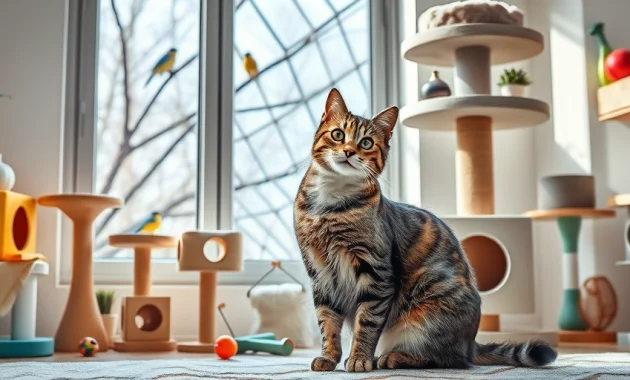
A cat tree or multi-tier climbing structure provides this vertical territory while also providing multiple activity options: climbing, jumping between levels, scratching on the sisal or rope elements, resting on elevated platforms, and reaching window height for outdoor viewing. The investment in a sturdy, tall cat tree positioned near a window is probably the single highest-return physical purchase for a cat's environmental quality.
Wall-mounted cat shelving — dedicated cat shelves arranged in staircase patterns that allow cats to walk up and across walls — is an increasingly popular alternative or complement to cat trees, particularly in smaller spaces where floor footprint is limited. Done thoughtfully, a wall circuit that takes the cat from floor to near-ceiling level and allows them to traverse a room at height provides an entire new dimension of territory within the existing space.
The window access element is important enough to deserve its own emphasis. A cat who can comfortably see outside from a window they use regularly has access to what's sometimes called "cat TV" — a continuously changing visual environment that provides sensory stimulation without any active effort from the owner. Birds at a feeder near the window, squirrels in a tree, passing pedestrians, blowing leaves, rain patterns — all of these provide genuine visual engagement. Adding a bird feeder just outside a window your cat uses multiplies the outdoor viewing value substantially.
Strategy Four: Olfactory and Tactile Enrichment
Cats experience the world substantially through smell in ways that humans, with our comparatively poor olfactory systems, often fail to appreciate or provide for. Cats have approximately 65 million olfactory receptors to our 15 million, and their olfactory experience of an environment is rich with information we simply cannot access. Providing olfactory novelty — new smells to investigate and respond to — is a form of enrichment that's often overlooked but genuinely engaging for cats.
Catnip (Nepeta cataria) is the most widely known feline-specific olfactory enrichment tool, and it works through a compound called nepetalactone that triggers a temporary euphoric response in cats who are genetically sensitive to it (roughly 50-70% of cats respond; the response is hereditary). Catnip can be sprinkled on toys, in specific areas, or on scratching posts to produce both the immediate sensory response and an associated positive experience with those items. Catnip's effects last roughly 10-15 minutes, after which a refractory period of several hours applies before the cat can respond again.
Silver vine (Actinidia polygama) is a plant from Asia that triggers a similar but reportedly stronger and more universal response than catnip, effective in cats who don't respond to nepetalactone. Silver vine sticks or powder are increasingly available through pet specialty retailers.
Cat grass — typically wheat grass, oat grass, or barley grass grown specifically for cats — provides both olfactory interest and the fiber intake that cats who eat grass naturally seek for hairball management and digestive support. Growing cat grass in a pot the cat can access converts an empty windowsill into an interactive resource.
Cardboard boxes are consistently underrated as free enrichment tools. Cats are strongly attracted to enclosed spaces — likely reflecting an ancient instinct for concealment during rest and during stalking — and a cardboard box placed on the floor provides an immediately attractive exploration, hiding, and play resource. The cardboard texture also provides an appropriate scratching surface. Rotating boxes when they become worn maintains novelty.
Paper bags and paper products are similarly attractive to many cats, providing crinkle sounds, new smells from wherever they've been, and enclosed spaces to investigate.
Strategy Five: Social and Cognitive Enrichment
Clicker training and trick training often surprises cat owners who assume cats can't be trained, but cats are intelligent animals who can learn a substantial repertoire of behaviors through positive reinforcement. Teaching a cat to sit, high-five, spin, jump to a target, ring a bell, or navigate through obstacles provides exactly the kind of cognitive engagement that a bored cat lacks. The training sessions themselves — typically five minutes each, one to three times daily — also provide structured human-cat interaction time that strengthens the bond and gives the cat a meaningful activity to engage in.
The key is purely positive reinforcement (reward-based, never punishment-based), keeping sessions short to match the cat's attention span, and choosing a high-value reward (a small piece of favorite food or treat) that motivates genuine engagement. A cat who has begun to engage with clicker training will often seek out the training sessions, which is itself a sign of healthy behavioral engagement.
The second cat question comes up frequently in discussions of cat enrichment: would getting a second cat address the boredom? The honest answer is: sometimes yes, sometimes no, and sometimes it creates more problems than it solves. Cats are not universally social with each other the way dogs are — some cats benefit enormously from feline companionship; others find a new cat a stressor that competes with the enrichment benefit. Before adding a second cat primarily for enrichment purposes, it's worth honestly assessing the individual cat's social temperament and researching careful introduction protocols that give the relationship the best chance of success.
Common Mistakes in Addressing Cat Boredom
Providing Objects Without Activities
The most common enrichment mistake is buying things — toys, trees, scratching posts — and placing them in the environment without creating the conditions for those objects to actually produce enrichment. A toy on the floor is not an activity. A cat tree in the corner that the cat doesn't use is furniture. The difference between an enrichment resource and a piece of furniture is whether it produces behavioral engagement.
Making cat trees attractive requires placement (near windows, near where the cat already likes to be), making climbing rewarding (treats placed at different levels, positive interactions with the cat on the tree), and ensuring the tree is stable and sturdy enough that the cat trusts it.
Making toys effective requires active engagement during play rather than leaving them out for passive interaction, rotation that maintains novelty, and observation of what types of toys and movement actually trigger genuine predatory interest in your specific cat.
Inconsistency in Play Schedules
Cats are creatures of routine whose anxiety is reduced by predictable schedules. Irregular, spontaneous play sessions provide some benefit but miss the opportunity that consistency creates: a cat who knows that interactive play happens at specific times will orient toward those times with anticipation, which is itself a form of positive engagement. The anticipation of a predictable rewarding event is neurologically distinct from passive waiting and is associated with positive emotional states in animals.
Two dedicated play sessions daily — morning and evening, or two evening sessions for working households — at approximately consistent times creates a routine structure that serves the cat's wellbeing beyond the direct enrichment of the sessions themselves.
Stopping Too Early in Play
Related to consistency is the issue of duration and completion. A play session that ends abruptly because the owner has moved on to something else, without letting the cat complete the predatory sequence with a catch-and-kill resolution, leaves the cat in an aroused but frustrated state. This is worse than not playing at all in some respects because the arousal has been raised without being satisfied.
Ten to fifteen minutes of genuine active play, ending with the cat successfully catching the toy and spending a few moments biting and kicking it, followed by a treat (simulating the consumption that follows a kill in the wild), provides the full behavioral loop that produces satisfaction rather than frustration.
Ignoring Individual Preferences
Cats are individuals with distinct preferences for types of play, types of toys, types of enrichment, and types of interaction. The confident generalization that "all cats like feather wands" is mostly true but not universally so — some cats are more engaged by ground-level prey movement than by aerial prey. Some cats prefer stalking and ambush over direct chase. Some cats are highly food-motivated for puzzle feeders while others are relatively uninterested in food outside of meals.
Paying attention to what actually produces genuine engagement in your specific cat — observing the body posture, the focused attention, the forward-leaning engagement that distinguishes genuine interest from polite tolerance — allows you to invest your enrichment effort where it actually pays off.
When Behavioral Change Requires Veterinary Assessment
The Overlap Between Boredom Symptoms and Medical Symptoms
Throughout this guide, the same warning has appeared multiple times: several of the signs of feline boredom overlap substantially with symptoms of medical conditions, and that overlap makes professional assessment essential before attributing behavior to boredom alone.
Overgrooming and hair loss can be psychogenic (stress and boredom-driven) or dermatological (allergic skin disease, parasites, fungal infection, hormonal conditions). The visible presentation — bald patches, thin coat, reddened skin — is often identical between these causes. Diagnosing psychogenic alopecia requires ruling out skin disease first.
Inappropriate elimination can be stress behavioral, territory marking, litter box aversion, or any of several medical conditions including urinary tract infection, urinary obstruction, kidney disease, diabetes, or hyperthyroidism. Medical causes of inappropriate elimination are often serious and some are urgent, which makes veterinary evaluation the first step rather than an optional follow-up.
Sudden weight changes in either direction — obesity from overeating boredom or weight loss from stress-related reduced appetite — warrant medical evaluation to rule out endocrine disorders (hyperthyroidism, diabetes), gastrointestinal disease, or other systemic conditions.
Sudden behavioral changes generally — a cat who was previously calm becoming suddenly aggressive, a cat who was previously active becoming suddenly lethargic — are more likely to have medical causes than behavioral causes, because genuine behavioral changes tend to develop gradually while medical changes can be relatively sudden.
The principle is simple and important: behavioral intervention and environmental enrichment are the right responses to boredom-driven behavior in a cat who has been medically evaluated and found healthy. They're potentially dangerous mismanagement of a medically ill cat if medical causes haven't been properly excluded.
Conclusion: Enrichment Is Not Optional — It's Basic Care
The framing of environmental enrichment as an add-on, a luxury, something to consider if you have time and money beyond the basics — this framing is wrong, and it does cats harm. For an indoor cat, environmental enrichment that meets their behavioral needs is as fundamental to their welfare as adequate food, water, and veterinary care. An indoor cat without adequate enrichment is not thriving; they're surviving in a condition that produces chronic psychological suffering.
The good news is that meeting these needs doesn't require elaborate setups or large budgets. Two fifteen-minute play sessions with a wand toy. A bird feeder near a window. Kibble hidden in small piles around the house instead of in a bowl. A cardboard box on the floor. A cat tree near the best window. These are the foundations, and most of them cost very little or nothing. What they require is attention — attention to what your cat is communicating, attention to whether the enrichment you're providing is actually producing engagement, and attention to the early warning signs that suggest something needs to change.
A cat who is behaviorally well, physically healthy, and living in an environment that meets their needs is a genuinely different kind of companion from one who is chronically understimulated and expressing that through problem behaviors. The investment in enrichment returns itself many times over in a healthier, more engaged, more contented animal — and in a household where the furniture survives.
FAQ
1. How can I tell if my cat is bored?
Bored cats often display noticeable behavioral changes, including excessive meowing, destructive scratching, overeating, oversleeping, overgrooming, aggression, pacing, or a lack of interest in their surroundings.
2. Why do indoor cats become bored?
Indoor cats have limited opportunities to hunt, climb, explore, and solve problems compared to outdoor cats. Without sufficient physical and mental stimulation, boredom can develop over time.
3. Is boredom harmful to cats?
Yes. Chronic boredom can contribute to stress, anxiety, obesity, behavioral problems, and reduced overall well-being if left unaddressed.
4. Why is my cat meowing constantly?
Excessive vocalization may be your cat's way of seeking attention, playtime, or interaction. However, persistent meowing can also indicate illness, pain, or cognitive decline, especially in older cats.
5. Can boredom cause destructive scratching?
Yes. Cats naturally scratch to maintain their claws, stretch their muscles, and mark territory. Without appropriate scratching surfaces or enrichment, they may redirect this behavior toward furniture, carpets, or curtains.
6. Why is my cat overgrooming?
Stress, anxiety, or boredom can trigger compulsive grooming that may result in bald patches or irritated skin. Medical conditions such as allergies or parasites should also be ruled out by a veterinarian.
7. Can boredom make cats aggressive?
Yes. A bored cat may redirect excess energy into chasing, stalking, or fighting with other pets or even people.
8. Why does my cat seem lazy all of a sudden?
While cats naturally sleep between 12 and 16 hours per day, excessive sleeping combined with reduced curiosity or activity may indicate boredom or an underlying health issue.
9. Can boredom cause overeating?
Yes. Some cats eat simply because they lack other forms of stimulation. This behavior can eventually contribute to obesity if calorie intake isn't controlled.
10. Why is my cat sleeping more than usual?
Cats often sleep to pass the time when they lack opportunities for play and exploration. However, sudden increases in sleeping should also be evaluated by a veterinarian.
11. Can boredom cause litter box problems?
Yes. Stress caused by boredom may contribute to inappropriate urination or defecation. However, urinary tract infections, bladder stones, or other medical problems must always be ruled out first.
12. Why does my cat pace around the house?
Relentless pacing, especially when combined with vocalization, may indicate frustration, boredom, anxiety, or a desire to hunt and explore.
13. When should I contact a veterinarian?
Consult your veterinarian if your cat develops:
- Sudden aggression
- Excessive grooming
- Weight changes
- Litter box accidents
- Persistent lethargy
- Significant behavioral changes
These symptoms may indicate an underlying medical condition rather than boredom alone.
14. How much playtime does an indoor cat need?
Most cats benefit from two daily interactive play sessions lasting 10–15 minutes each, especially with wand toys that imitate prey movement.
15. Why should I rotate my cat's toys?
Cats quickly lose interest in toys that remain available all the time. Rotating toys every week keeps them novel and mentally stimulating.
16. Are laser pointers good for cats?
Yes, but always end the session by allowing your cat to "catch" a physical toy or treat. This helps satisfy their hunting instinct and reduces frustration.
17. What are puzzle feeders?
Puzzle feeders require cats to solve simple challenges before accessing food, providing valuable mental stimulation while slowing down eating.
18. Can hiding food reduce boredom?
Absolutely. Hiding small portions of kibble around the house encourages natural foraging and hunting behaviors, making mealtime more engaging.
19. Why do cats enjoy climbing?
Cats naturally seek elevated positions for safety, observation, and territory monitoring. Vertical spaces satisfy these instincts and increase environmental enrichment.
20. What are the best climbing options?
Popular choices include:
- Cat trees
- Floating wall shelves
- Window perches
- Multi-level climbing furniture
21. What is "Cat TV"?
"Cat TV" refers to a window view where cats can safely watch birds, squirrels, insects, pedestrians, or moving vehicles, providing hours of visual entertainment.
22. Does catnip help relieve boredom?
Many cats respond positively to catnip, which can encourage play, scratching, and exploration. However, not all cats are genetically sensitive to it.
23. Why are scratching posts important?
Scratching posts allow cats to:
- Maintain healthy claws
- Stretch muscles
- Mark territory
- Relieve stress
- Redirect scratching away from furniture
24. Can another cat reduce boredom?
In some households, a compatible feline companion can provide social interaction and play. However, proper introductions and personality compatibility are essential.
25. How often should I introduce new enrichment?
Changing toys, hiding treats, rearranging climbing areas, or introducing new activities every few weeks helps maintain curiosity and prevent boredom.
26. Can boredom contribute to obesity?
Yes. Reduced activity combined with boredom-related overeating can significantly increase the risk of weight gain and obesity.
27. What are the best toys for bored cats?
Excellent enrichment toys include:
- Wand toys
- Feather teasers
- Interactive balls
- Puzzle feeders
- Treat-dispensing toys
- Kick toys
- Motion-activated toys
28. Is environmental enrichment expensive?
Not necessarily. Many enrichment activities are inexpensive, such as cardboard boxes, paper bags (without handles), homemade puzzle feeders, window perches, and scheduled interactive play.
29. Can boredom affect a cat's mental health?
Yes. Long-term boredom can contribute to chronic stress, anxiety, frustration, and depression-like behaviors in cats.
30. What is the best way to prevent boredom?
A combination of daily interactive play, rotating toys, puzzle feeding, climbing opportunities, scratching posts, window views, and regular human interaction provides the most effective long-term enrichment for indoor cats.