The Biomechanical Ballet: Deconstructing the Feline Air-Righting Reflex
2 months ago
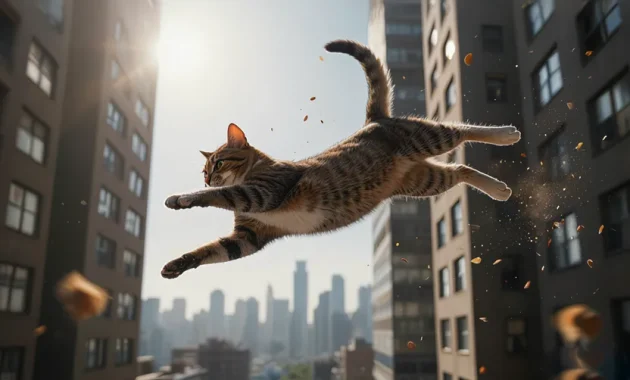
For centuries, the uncanny ability of felines to survive falls that would be fatal to other organisms has baffled physicists, veterinarians, and biologists. Whether slipping from a living room mantlepiece or falling from a multi-story balcony, a cat displays an almost supernatural capacity to reorient its body midair, ensuring it lands squarely on all four paws.
Historically treated as an abstract mathematical paradox, this phenomenon—known scientifically as the air-righting reflex—has finally been decoded at a granular anatomical level. A landmark 2026 study published in The Anatomical Record by Dr. Yasuo Higurashi and his team at Yamaguchi University’s Laboratory of Veterinary Physiology and Biochemistry has revealed the exact physical mechanisms at play. The secret lies not just in rapid neurological reflexes, but in a profound structural asymmetry between the front and rear halves of the feline spine.
This deep dive explores the physics, neurology, and structural mechanics behind the feline air-righting reflex, while analyzing the clinical realities of High-Rise Syndrome.
The Physics Paradox: Falling Without Angular Momentum
To appreciate the complexity of a cat's midair twist, one must first understand a fundamental law of classical mechanics: The Conservation of Angular Momentum.
According to this law, an object that is not rotating cannot suddenly begin rotating without an external force pushing against it. When a cat slips from a ledge, it has zero initial angular momentum. In midair, there is nothing for the cat to push off against—air resistance is negligible at the start of a fall. Under strict Newtonian physics, a rigid body falling upside down should remain upside down until impact.
                  [The Zero Angular Momentum Fall]
                                 │
         ┌───────────────────────┴───────────────────────┐
         ▼                                               ▼
[Rigid Object Dynamics]                         [Deformable Body Dynamics]
• Rotation requires external torque.            • Internal deformation creates rotation.
• Object remains upside down.                   • Upper and lower body rotate oppositely.
• Direct impact on spine/head.                  • Net angular momentum remains ZERO.
How, then, does the cat manage to turn itself right side up? The answer is that a cat is not a rigid cylinder; it is a deformable body capable of changing its shape midair. By twisting different segments of its torso in opposite directions at precise intervals, a cat can rotate its entire frame while keeping its total, net angular momentum exactly at zero. Physicists call this the "tuck-and-twist" method, and it is the same mechanical strategy used by Olympic divers and professional gymnasts.
Spinal Anatomy: The Differential Flexibility Matrix
While physicists have understood the mathematical math behind this twist for decades, Dr. Higurashi’s 2026 study uncovered the exact biological hardware that makes it possible. By analyzing the structural stiffness of the feline vertebral column, the researchers discovered that the spine is split into two distinct mechanical zones.
       [Anterior: Thoracic Zone]                 [Posterior: Lumbar Zone]
       • Vertebrae: T1 - T13                     • Vertebrae: L1 - L7
       • Low torsional stiffness                 • High torsional stiffness
       • Maximum "slack" motion                  • Stiff, resistant to twisting
       • Rotates instantly                       • Functions as a solid lever
The Highly Flexible Thoracic Engine
The anterior (front) half of the cat’s torso is built around the thoracic spine, consisting of 13 vertebrae (T1–T13) connected to the ribcage. Dr. Higurashi’s team discovered that this region possesses an extraordinarily low level of torsional stiffness.
When a cat begins to twist, the thoracic spine displays a wide range of "slack motion." This lack of structural resistance allows the cat to rotate its head, shoulders, and front limbs with incredible speed, completely independent of its hindquarters.
The Stiff Lumbar Anchor
In stark contrast, the posterior (rear) half of the cat's torso is supported by the lumbar spine, made up of 7 large vertebrae (L1–L7). The Yamaguchi University study revealed that the lumbar spine is highly resistant to twisting.
This localized stiffness is critical: if the entire spine were uniformly flexible, the cat’s body would twist wildly into a spiral without making any real forward progress. Instead, the stiff lumbar region acts as a solid mechanical anchor and lever, allowing the rear legs to push off against the upper body's momentum.
The 3-Phase Kinematic Sequence
When a cat falls, its body executes a highly coordinated, lightning-fast three-phase movement sequence to correct its orientation. The entire process takes less than a fraction of a second.
[Phase 1: Tuck & Twist] ──► [Phase 2: Extend & Unfurl] ──► [Phase 3: Parachute Shock Absorb]
Front paws tuck in.         Front paws extend out.         Spine arches upward.
Hind legs extend out.       Hind legs tuck in.             All four limbs drop.
Shoulders rotate 180°.      Pelvis snaps into place.       Spars kinetic energy safely.
Phase 1: The Tuck and Twist (Anterior Rotation)
The moment a fall begins, the cat’s fluid-filled inner ear (vestibular apparatus) detects the drop and calculates which way is down. The cat instantly alters the inertia of its body by adjusting its legs:
-
It tucks its front paws tight against its chest, significantly lowering the rotational resistance (moment of inertia) of its upper body.
-
Simultaneously, it extends its rear legs fully outward, maximizing the rotational resistance of its lower body.
Because the front half is easy to turn and the back half is hard to turn, the cat can use its upper-body muscles to twist its shoulders a full 180 degrees toward the ground, while the heavy rear legs barely move in the opposite direction.
Phase 2: The Extend and Unfurl (Posterior Realignment)
Once its head and front paws are facing the ground, the cat instantly reverses its limb positions to bring its back half around:
-
It extends its front paws outward, locking them in place to stop the upper body from over-rotating.
-
Simultaneously, it tucks its rear legs in tight, dropping the rotational resistance of its hindquarters.
The cat then contracts its deep core muscles. Using the stiff lumbar spine as a lever, the lower body easily snaps around into alignment with the already turned upper body. The cat is now completely right side up.
Phase 3: The Parachute and Shock Absorption
With all four paws facing downward, the cat prepares for impact. It arches its back dorsally to maximize the distance between its belly and the ground, acting much like a parachute to catch air resistance.
As it lands, the cat’s flexible shoulder blades, leg muscles, and joints bend smoothly to absorb the kinetic energy of the impact, safely spreading the force across its musculoskeletal system.
High-Rise Syndrome: The Limits of Biological Engineering
Despite the brilliance of this evolutionary reflex, a cat’s body is not invincible. In veterinary medicine, injuries resulting from severe vertical falls are classified under High-Rise Syndrome.
                                [High-Rise Syndrome Injury Curve]

   1-2 Stories: Minor Bruising ──► 2-6 Stories: Fractures & Trauma ──► 7+ Stories: Terminal Relaxation
   (Low kinetic energy)            (High energy impact forces)          (Terminal velocity reached)
A common paradox in veterinary statistics shows that cats falling from mid-story windows (between 2 and 6 stories) often suffer more severe injuries than those falling from higher up (above 7 stories). This counterintuitive curve is directly tied to the physics of acceleration and terminal velocity:
When a cat falls past 6 stories, it reaches terminal velocity—the point where air resistance matches the downward pull of gravity, halting further acceleration. Once this steady speed is reached, the cat's inner ear stops feeling the sensation of falling.
This causes the cat to relax its muscles and spread its legs out horizontally, creating a "flying-squirrel" shape. This posture increases drag, slows the descent, and distributes the landing impact more evenly across the entire body, leading to surprisingly high survival rates—though still resulting in serious internal trauma.
Summary: Designing a Safer Feline Environment
The 2026 Yamaguchi University study highlights the specialized biology of the domestic cat, demonstrating how a flexible thoracic spine and a stiff lumbar spine work together to conquer the laws of physics. However, because our modern high-rise environments present fall risks far beyond what nature intended, pet owners must take active precautions. Installing heavy-duty window screens, securing open balconies, and eliminating high-altitude hazards are essential steps to keep your cat's remarkable biomechanics safely on solid ground.
FAQ (Frequently Asked Questions)
Q1: How do cats always land on their feet when they fall?
Cats use a biological mechanism called the air-righting reflex, which allows them to reorient their body midair. They combine inner ear balance detection with rapid spinal twisting to rotate their body without violating the conservation of angular momentum.
Q2: Do cats actually rotate in midair or is it an illusion?
They genuinely rotate in midair. The movement is real and biomechanically controlled through coordinated changes in body position—tucking and extending limbs to shift rotational inertia between the front and rear halves of the body.
Q3: What part of a cat’s body makes this rotation possible?
The key structure is the highly flexible thoracic spine, paired with a more rigid lumbar spine. This dual-structure system allows the front and back halves of the body to rotate independently and efficiently.
Q4: Can cats break their fall from any height?
No. While cats are highly adaptable, they are not invincible. Falls from medium heights (2–6 stories) can actually cause more severe injuries due to insufficient time to reach a stable body posture and reduce impact force.
Q5: Why are falls from higher floors sometimes less deadly for cats?
At higher heights, cats can reach terminal velocity, which allows them to relax their body, spread out their limbs, and increase air resistance—reducing impact severity compared to uncontrolled acceleration at lower heights.
Q6: What is High-Rise Syndrome in cats?
High-Rise Syndrome refers to injuries sustained from falls from significant heights. These can include fractures, internal injuries, and trauma caused by impact forces even when the cat successfully orients itself midair.
Q7: Do cats feel fear or panic while falling?
Yes. Cats experience a rapid stress response during a fall, but the reflex activates almost instantly. However, excessive panic or disorientation can still affect their ability to land safely.
Q8: Is a cat’s spine specially adapted for falling?
Yes. The feline spine is highly flexible in the thoracic region and more rigid in the lumbar region, allowing controlled twisting and stabilization during midair rotation.
Q9: Can kittens perform the same midair righting reflex?
Kittens develop the reflex gradually. Very young kittens may not fully coordinate the movement until their vestibular system and muscular control are sufficiently developed.
Q10: How can cat owners prevent fall injuries?
Installing secure window screens, balcony barriers, and preventing access to high open ledges are the most effective ways to prevent accidental falls.