The Feline Energetics Blueprint: Caloric Architecture, Macronutrient Dynamics, and Clinical Feeding Methodologies
2 months ago
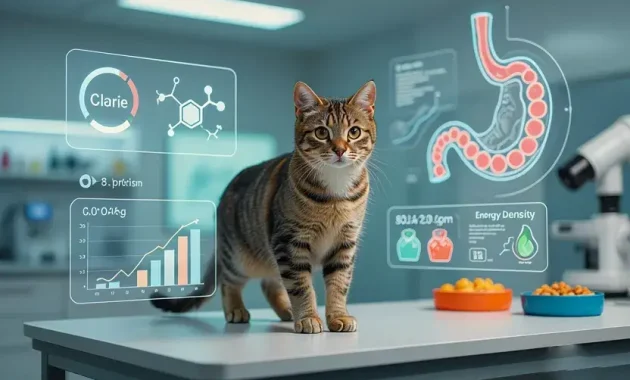
Determining the precise dietary portions for a domestic feline requires an balance of physiological science, metabolic calculation, and behavioral management. In feline veterinary medicine, nutritional management is moving away from arbitrary volumetric measurements (such as "cups per day") toward precise metabolic energy profiling.
Because the domestic feline is an obligate carnivore, its metabolic machinery is strictly adapted to process specific nutrient ratios. Incurring a chronic caloric surplus leads to adipocyte hypertrophy and feline obesity, while an unmanaged caloric deficit induces muscle wasting and triggers hepatic lipidosis.
This comprehensive technical guide serves as an operational manual for calculating, converting, and scheduling dietary portions for felines across every major life stage.
Metabolic Architecture: Caloric Demands Across Feline Life Stages
Feline energy requirements are calculated using Metabolizable Energy (ME), quantified in kilocalories (kcal) per kilogram of body weight ($kg \text{ BW}$). A cat's daily energy requirement (DER) is not a fixed metric; it is a fluid variable dictated by age, metabolic rate, reproductive status, and cellular growth curves.
                  [Feline Life Stage Energetics]
                                │
         ┌──────────────────────┼──────────────────────┐
         ▼                      ▼                      ▼
 [Juvenile Growth]      [Adult Maintenance]    [Senescent Decline]
 • 30 kcal/kg BW        • 66 kcal/kg BW        • 50 kcal/kg BW
 • High metabolic rate  • Homeostatic plateau  • Decreased digestive efficiency
Juvenile Growth Phase (Kittens)
During the initial months of life, a kitten’s metabolic rate is geared toward rapid skeletal and cellular growth. Surprisingly, their baseline energy demands per kilogram are lower than an active adult because their small body mass restricts total daily capacity, requiring a lean baseline of 30 kcal per kilogram of body weight. However, their diets must feature high nutrient density to prevent developmental stalls.
Adult Maintenance Phase
Upon reaching physical maturity (typically around 12 months of age), the feline metabolic rate stabilizes into an adult plateau. A healthy, altered adult cat requires an average of 66 kcal per kilogram of body weight to maintain homeostatic mass. At this stage, unmeasured portions quickly turn into stored adipose tissue.
Geriatric and Senescent Phase (Senior Cats)
As cats pass 7 to 10 years of age, their digestive tract efficiency declines, particularly their ability to absorb complex fats and proteins. To prevent senescent muscle wasting (sarcopenia), the caloric target shifts to 50 kcal per kilogram of body weight, emphasizing highly digestible, premium protein sources.
Macronutrient Profiling: The Feline Protein Requirement
Beyond total calorie counts, you must ensure your cat receives proper macronutrient distribution, specifically regarding obligate protein requirements.
[Adult Feline Weight: 4.0 kg] ──► [Linear Protein Factor: 4.5g / kg] ──► [Daily Target: 18.0g Pure Protein]
Unlike omnivores, felines possess an unregulation of hepatic amino acid catabolizing enzymes. This means their bodies continuously break down protein for energy, regardless of how much protein they actually consume.
-
The Adult Baseline: An adult feline requires a minimum baseline of 4.5 grams of pure protein per kilogram of body weight daily.
-
Clinical Math: For a standard 4.0 kg adult maintenance cat, this translates to an absolute minimum requirement of 18 grams of pure protein per day.
-
Amino Acid Profiles: This protein must be rich in essential animal-sourced amino acids, specifically taurine, arginine, and methionine, which felines cannot synthesize on their own.
Mathematical Conversion: Converting Kilocalories into Grams
To apply abstract calorie targets to physical food bowls, you must calculate the diet's Energy Density, which is typically listed on commercial pet food packaging as kilocalories per kilogram ($kkal/kg$) or kilocalories per gram ($kkal/g$).
The Core Allocation Formula
To calculate the precise weight of dry or wet food your cat needs each day, use this linear algebraic formula:
A Practical Laboratory Simulation
Consider a standard adult feline weighing 4.0 kg with a calculated daily energy requirement of 264 kcal ($4.0 \text{ kg} \times 66 \text{ kcal/kg}$).
-
Identify Energy Density: The selected dry kibble has an energy density of $3,340 \text{ kcal/kg}$, which breaks down to $3.34 \text{ kcal/gram}$.
-
Calculate Gram Volume:
$$\frac{264 \text{ kcal}}{3.34 \text{ kcal/g}} = \mathbf{79.04 \text{ grams per day}}$$ -
Divide by Feeding Frequency: If you feed your cat twice a day (Pagi & Sore), you must serve exactly 39.52 grams per meal.
[Daily Need: 264 kcal] ÷ [Density: 3.34 kcal/g] = [Total Food: 79.04g] ──► [Per Meal: 39.52g]
Scheduling Protocols and Feeding Automations
Felines are crepuscular predators instinctively hardwired for fixed daily routines. Maintaining a consistent feeding schedule stabilizes insulin secretion, reduces stress-induced behaviors, and keeps their elimination habits regular.
                     [Feeding Delivery Systems]
                                 │
         ┌───────────────────────┴───────────────────────┐
         ▼                                               ▼
[Manual Multi-Meal Delivery]                    [Digital Micro-Dispensing]
• Direct wet/dry interaction.                   • Automated, calculated portions.
• Maximum portion regulation.                   • Eliminates behavioral begging.
• Restricted 30-minute window for wet food.    • Confined strictly to dry kibble.
Manual Multi-Meal Delivery
Feeding your cat twice daily—once in the morning and once in the evening—allows you to easily feed a combination of wet and dry food. This setup is excellent for ensuring optimal hydration and preventing urinary tract issues. However, wet food must be removed after 30 minutes to avoid oxidation and bacterial growth.
Automated Digital Micro-Dispensing
For owners with erratic schedules, a smart digital feeder provides a precise way to manage your cat's portions. These devices break down the total daily gram requirement into 4 to 6 microscopic meals throughout the day, closely mimicking a cat's natural hunting patterns. This approach lowers the risk of post-meal vomiting and prevents the common behavioral issues associated with free-feeding.
Summary: A Metric Approach to Long-Term Feline Health
Managing your cat's nutrition is one of the most effective ways to support their long-term health. By calculating exact caloric needs based on life stage, confirming necessary protein levels, and using a digital scale to measure precise gram weights rather than relying on loose volumetric estimates, you protect your cat from metabolic stress and increase their life expectancy.
FAQ (Frequently Asked Questions)
Q1: How many calories should I feed my cat per day?
A cat’s daily calorie requirement depends on its life stage, weight, and activity level. On average, adult cats require around 60–70 kcal per kg of body weight per day, while kittens require more due to growth demands and senior cats slightly less due to reduced metabolism. Always calculate based on Metabolizable Energy (kcal) rather than volume-based feeding like “cups.”
Q2: Why is measuring cat food in grams better than cups?
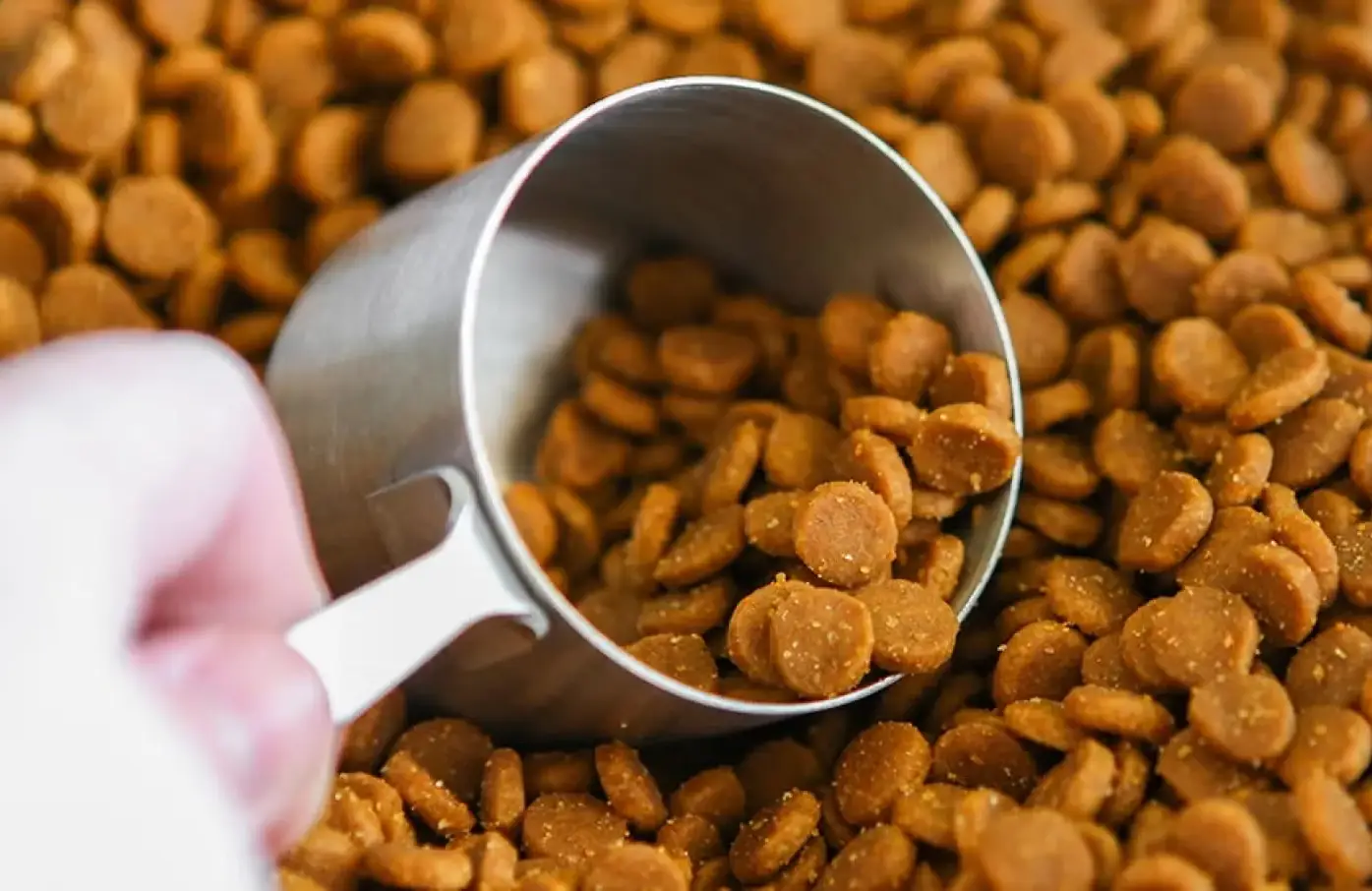
Measuring in grams ensures precision and consistency, while cup measurements vary depending on kibble shape, density, and packing method. Using grams aligned with energy density (kcal/g) allows accurate control of calorie intake, preventing both obesity and malnutrition.
Q3: What happens if I suddenly change my cat’s diet?
A sudden diet change can cause intestinal dysbiosis, diarrhea, vomiting, and appetite loss. The feline gut microbiome adapts slowly to food composition, so abrupt changes disrupt enzyme balance and bacterial populations. A 7-day gradual transition is recommended.
Q4: How do I calculate how much food my cat needs daily?
Use this formula:
Daily Food (g) = Daily Energy Requirement (kcal) ÷ Food Energy Density (kcal/g)
Example: A 4 kg cat needing 264 kcal/day eating food with 3.34 kcal/g requires ~79 g of food per day.
Q5: How often should I feed my cat per day?
Most adult cats do well with 2 meals per day, while kittens may require 3–5 smaller meals. Automated feeders can divide total intake into 4–6 micro-meals to mimic natural hunting patterns and stabilize metabolism.
Q6: What is the biggest risk of overfeeding a cat?
Chronic overfeeding leads to adipose tissue expansion, leptin resistance, and systemic inflammation, increasing the risk of obesity, diabetes mellitus, joint degeneration, and reduced lifespan.
Q7: Can senior cats eat the same food as adult cats?
Not ideally. Senior cats typically require lower calories (around 50 kcal/kg) but higher digestibility in protein and fat to prevent muscle wasting (sarcopenia) and support organ function.
Q8: Why does my cat act hungry all the time even after eating?
This can result from leptin resistance, poor diet composition (low protein or high fillers), or feeding low-satiety foods. It may also be behavioral or stress-related, not true caloric deficiency.
Q9: Is free-feeding bad for cats?
Free-feeding can lead to uncontrolled caloric intake, making it difficult to track energy balance. It increases obesity risk, especially in indoor cats with low activity levels.
Q10: What is the safest way to transition cat food?
A gradual 7-day transition protocol is safest:
- Days 1–2: 75% old / 25% new
- Days 3–4: 50% / 50%
- Days 5–6: 25% / 75%
- Day 7: 100% new food