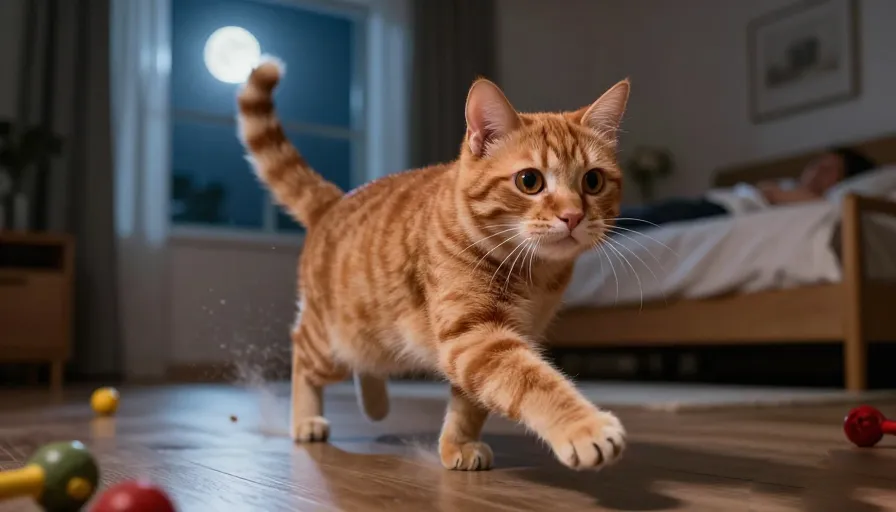
Every cat owner knows the exact feeling. You are drift into a deep, peaceful sleep, dreaming peacefully, when suddenly—thud! A furry, four-legged missile launches itself off your headboard, careens down the hallway, shreds the living room curtains, and slides across the hardwood floor like a miniature drift car.
It is 2:00 AM, and your cat has officially transformed into a midnight tornado.
This phenomenon, commonly referred to by pet parents as the “night zoomies,” can leave you feeling exhausted, sleep-deprived, and deeply confused. Why does a creature that spends 16 hours a day sleeping like a peaceful angel turn into a chaotic agent of destruction the second the house goes dark? Is your cat possessed, bored, or secretly plotting to overthrow your sleep schedule?
In this definitive, multi-chapter feline behavioral guide, we are going to dive deep into the evolutionary science, biological triggers, and psychological patterns behind your cat’s nighttime antics. Written from the perspective of an expert animal behaviorist, this manual will unpack the top 10 reasons behind this behavior and outline a complete framework to sync your cat’s sleep cycle with your own.
The Evolutionary Blueprint Crepuscular vs. Nocturnal Myths

To solve a mystery, you have to understand the history. One of the most common pieces of misinformation floating around the pet community is that domestic cats are naturally nocturnal creatures. How many times have you heard someone say, “Well, cats are active at night because they are nocturnal predators”?
Technically, this is incorrect.
                     THE FELINE ACTIVITY SPECTRUM

  [ NOCTURNAL ]   ──► Active strictly during the pitch-black hours of the night.
  [ CREPUSCULAR ] ──► Pinned to the golden hours—peak activity at Dawn and Dusk.
  [ DIURNAL ]     ──► Active during the bright, clear hours of daylight (Humans).
Evolutionarily speaking, the domestic cat (Felis catus) is a crepuscular species. This means their internal biological clocks, or circadian rhythms, are hardwired for peak activity during the twilight hours: dawn and dusk.
The Twilight Hunter’s Advantage
Why dawn and dusk? In the wild, a predator’s schedule is entirely dictated by the behavior of its prey. The small rodents, birds, reptiles, and insects that ancestral cats hunted are most active during these low-light periods. Hunting at twilight gives cats a massive optical and tactical advantage. Their eyes are structurally engineered to maximize minimal ambient light, allowing them to spot the slightest twitch of a mouse tail in the dim brush while remaining completely invisible to both their prey and larger, diurnal apex predators (like eagles or coyotes).
The Domestic Clash
When we bring these magnificent creatures into modern, human-centric homes, a structural schedule conflict occurs:
-
The Human Routine: We wake up after dawn, leave for work, return at dusk, watch television, and go to sleep during the dead of night.
-
The Feline Instinct: Your cat’s biological clock screams, “Wake up, it’s dusk! Time to hunt!” just as you are kicking off your shoes to relax. Then, their internal clock triggers again at 4:30 AM (dawn), shouting, “The sun is rising somewhere! Go stalk something!” while you are desperately trying to get your final two hours of REM sleep.
When this ancient biological programming has no natural outlet—meaning there are no physical mice to stalk or expansive fields to sprint across—it builds up inside your cat’s nervous system. The result? A sudden, uncontainable explosion of physical motion known scientifically as FRAPs (Frenetic Random Activity Periods), or more affectionately, the night zoomies.
The Top 10 Root Causes Behind Midnight Madness
While evolutionary biology lays the foundation for nighttime activity, it isn’t the only factor driving your cat’s midnight sprints. Feline behavior is highly nuanced and shaped by their immediate environment, physical health, age, and emotional state.
Let’s break down the top 10 reasons why your cat transforms into a high-speed athlete when the sun goes down.
                      THE MIDNIGHT ZOOMIES CAUSE MATRIX

                     ┌──────────────────────────────────┐
                     │  Is it Behavioral or Medical?   │
                     └────────────────┬─────────────────┘
                                      │
         ┌────────────────────────────┴────────────────────────────┐
         ▼                                                         ▼
   [ BEHAVIORAL TRIGGERS ]                                   [ MEDICAL ALARMS ]
   • Pent-up Daytime Energy                                  • Feline Hyperthyroidism
   • Attention-Seeking Loops                                 • Arthritis / Joint Pain
   • Cravings & Empty Stomachs                               • Cognitive Dysfunction (CDS)
   • Environmental Changes                                   • Feline Hyperesthesia
1. The Energy Deficit: Environmental Monotony
Consider the average life of an indoor domestic cat. The human owner wakes up at 7:00 AM, throws some kibble into a bowl, kisses the cat goodbye, and heads out the door for a 9-to-5 job. For the next nine to ten hours, the house is a silent tomb. There are no shifting shadows, no rustling leaves, no moving prey, and zero cognitive challenges.
To cope with this total lack of environmental stimulation, your cat does the only thing it can: it sleeps. They nap on the sofa, snooze on the windowsill, and doze on your bed. They enter a state of metabolic conservation, essentially storing energy all day long.
When you return home in the evening, your cat is thrilled to see you. But if your interaction consists of scooping fresh food into their bowl and then sitting on the couch to look at your phone or watch television, that massive reservoir of day-long energy remains completely untapped. By the time you turn off the lights and climb into bed, your cat’s internal battery is sitting at 100% capacity. Their body physically demands an outlet for that kinetic energy, leading to high-speed laps around your living room.
2. The Dopamine Rush of FRAPs (Frenetic Random Activity Periods)
Have you ever watched your cat right before a zoomie attack? Their eyes dilate until they look like pitch-black saucers, their ears twitch forward, and they might stare intently at a completely empty patch of wall before suddenly taking off at warp speed.
This is a classic textbook episode of FRAPs.
FRAPs are completely normal, healthy physiological events that occur in mammals, including cats, dogs, and even ferrets. Think of it as a emotional and physical pressure-release valve. As energy, adrenaline, and cortisol accumulate in a cat’s body, their nervous system reaches a tipping point. The sudden sprint is an involuntary, highly rewarding surge of dopamine that burns off that accumulated stress instantly. It is not an act of malice or defiance; it is a profound physiological reset button.
3. Chronic Attention-Seeking Behavior Loops
Cats are highly intelligent, intuitive creatures that learn exactly how to manipulate their human companions through classical conditioning. They quickly map cause-and-effect relationships within the home.
Imagine this common scenario: It’s 3:00 AM. Your cat starts running across your bed and meowing softly. You wake up, frustrated and exhausted. You roll over, look at your cat, sigh loudly, and say, “Stop it, shadow, go to sleep!” When the cat continues, you eventually get out of bed, walk to the kitchen, and toss a handful of treats into their bowl just to get them to leave you alone for an hour.
What did your cat just learn from this interaction?
                     THE ATTENTION-SEEKING REWARD LOOP

  [ Cat Sprints & Vocals ] ──► [ Owner Wakes Up ] ──► [ Vocal/Physical Contact ] ──► [ Treat Dispensed ]
In the mind of your cat, this is an absolute victory. They discovered that performing a midnight sprint results in a highly rewarding chain of events: they get vocal interaction, eye contact, physical proximity, and a midnight snack from their favorite human.
Even if you wake up and yell at your cat or pick them up to move them out of the room, negative attention is still attention to a lonely, under-stimulated cat. If the daytime hours are silent and empty, your cat will gladly take a midnight scolding just to feel connected to you.
4. Age-Related Metabolic Slopes (Kitten Energy vs. Senior Changes)
Age plays a defining role in how a cat manages its energy levels. If you have a kitten under the age of one, or a juvenile cat under the age of three, their baseline metabolic rate is incredibly high. Their bodies are rapidly developing muscles, bones, and neural pathways, all of which require a tremendous amount of play, exploration, and physical testing. For a young cat, night zoomies are par for the course unless you actively structure their day.
Conversely, if a calm, senior cat (aged 11 or older) suddenly starts pacing, running around frantically, or howling loudly in the dark, this is rarely a simple case of youthful playfulness. This behavior shift often points to Cognitive Dysfunction Syndrome (CDS), which is essentially the feline equivalent of dementia or Alzheimer’s disease.
As a cat’s brain ages, they can experience profound spatial disorientation, confusion, and memory lapses. When the house goes dark and silent, a senior cat with CDS can become terrified, losing track of where their litter box or water bowl is located. This confusion manifests as restless pacing, frantic running, and deep, guttural howling as they call out for reassurance.
5. Metabolic Intruders: Feline Hyperthyroidism
If your mature or senior cat has suddenly developed a wild, uncharacteristic burst of energy at night—accompanied by an insatiable appetite, increased thirst, and noticeable weight loss despite eating everything in sight—you are likely dealing with an underlying medical condition called Feline Hyperthyroidism.
                    HYPERTHYROIDISM SYSTEMIC IMPACT

  [ Benign Thyroid Nodules ] ──► Excessive Thyroxine (T4) ──► Jacked-Up Metabolism
                                                                    │
         ┌──────────────────────────────────────────────────────────┴──────────────────────────────────────────────────────────┐
         ▼                                                                                                                     ▼
   [ Physical Symptoms ]                                                                                                 [ Behavioral Quirks ]
   • Rapid Weight Loss                                                                                                   • Midnight Pacing
   • Insatiable Hunger                                                                                                   • Loud Night Vocalization
   • Chronic Over-Heating                                                                                                • Frantic Zoomies
Hyperthyroidism occurs when a cat’s thyroid gland develops benign nodules that overproduce thyroxine ($T_4$), the hormone responsible for regulating baseline metabolism. This floods their system with adrenaline, jacking up their heart rate and pushing their body into a permanent state of overdrive.
A hyperthyroid cat is physically incapable of resting comfortably. They feel constantly hot, chronically hungry, and intensely restless. When the house settles down at night, this metabolic surge drives them to pace the halls, run around frantically, and voice their discomfort.
6. The Phantom Itch: Feline Hyperesthesia Syndrome (FHS)
Have you ever noticed your cat suddenly biting at the base of its tail, twitching its back skin like a rolling wave, and then running away in absolute terror as if it’s being chased by an invisible monster? This distinct behavioral pattern could be a signs of an elusive neurological condition known as Feline Hyperesthesia Syndrome (FHS).
FHS, often called “twitchy skin syndrome,” is a complex neurological or dermatological disorder where a cat’s nervous system becomes hyper-sensitive to touch and environmental stimuli. The nerve endings along the spine and tail base experience sudden, spontaneous misfires—feeling to the cat like an intense electric shock, a sharp prick, or an overwhelming, unbearable itch.
When these phantom sensations strike in the middle of the night, the cat reacts with a sudden burst of adrenaline. They sprint across the house to escape the painful sensation on their own body, turning an involuntary nerve twitch into a midnight sprint.
7. Hidden Structural Discomfort: Arthritis and Joint Pain
Cats are masters of masking physical pain. In the wild, showing any sign of weakness makes a small predator vulnerable to larger threats, so domestic cats have evolved to hide chronic discomfort with incredible stoicism. They won’t limp, whine, or cry out when suffering from chronic joint issues like osteoarthritis, which affects over 60% of cats over six years old and a staggering 90% of cats over twelve.
Instead of limping during the day when they are distracted by household activity, a cat’s joint pain often becomes impossible to ignore when they try to settle down for a long night’s rest. As their joints stiffen up in the cooler evening air, the discomfort mounts.
To cope with this deep, aching pain, the cat may begin pacing the floor, shifting positions constantly, or running in short, frantic bursts to try and outrun the throbbing discomfort in their hips or lower spine.
8. The Midnight Hunger Shift
A cat’s stomach is relatively small—roughly the size of a ping-pong ball for an average 10-pound feline. Their digestive systems are built to process small, frequent meals throughout a 24-hour cycle, rather than digesting two large meals spaced 12 hours apart like humans.
                    THE MEAL-GAP SLEEP DISRUPTION

  [ 5:00 PM: Early Dinner ] ──► [ 2:00 AM: Stomach Empty / Acid Spike ] ──► [ Foraging Zoomies ]
If you feed your cat dinner early in the evening (say, 5:00 PM) and then go to bed at 11:00 PM, their stomach will be completely empty by 2:00 AM. That long, nine-hour gap causes an increase in stomach acid, triggering deep hunger pangs.
Driven by their predatory instincts to forage and find food when their stomach is empty, your cat wakes up, starts searching every corner of the house, and runs around in a frustrated attempt to locate a late-night snack.
9. Micro-Ecosystem Intrusion: Outdoor Wildlife Proximity
Your home is not a completely sealed bubble. Even if your cat stays strictly indoors, their sensory world extends far beyond your exterior walls. A cat’s hearing is a marvel of evolutionary engineering: they can detect ultra-high frequencies up to 64,000 Hz (compared to just 20,000 Hz in humans), allowing them to hear the high-pitched squeaks of a mouse or the rustle of a nocturnal animal outside through thick insulation.
When the neighborhood goes quiet at night, the local wildlife comes out to play. Raccoons, opossums, stray cats, mice, or owls may be roaming right outside your living room window or scurrying through the crawlspaces under your floors.
Your cat hears these micro-movements with perfect clarity. Blocked by walls from actually chasing the target, their hunting instinct turns into intense frustration. They sprint back and forth across the room, bouncing off windowsills and furniture in an attempt to reach the inaccessible prey outside.
10. The Safe Haven Effect: Rescue and Skittish Psychology
For cats that are naturally timid, anxious, or have a history of trauma (such as rescue cats transitioning from a crowded shelter), the daytime environment can be deeply intimidating. The constant noise of vacuum cleaners, ringing doorbells, loud televisions, walking humans, and crying children keeps their nervous systems on high alert, forcing them to hide under beds or behind couches all day long.
                     THE SKITTISH CAT COMFORT WINDOW

  [ DAYLIGHT HOURS ] ──► Human Noise / High Threat Matrix ──► Hidden / State of Fright
                                                                    │
                                                                    ▼
  [ TWILIGHT HOURS ] ──► Silent House / Zero Threat Matrix ──► Total Freedom / Night Zoomies
The second the lights go out and the human family falls asleep, the environment undergoes a radical transformation. The terrifying noises vanish, the movement stops, and the house becomes perfectly safe and quiet.
For a skittish cat, midnight is their golden window of freedom. Finally feeling safe and unmonitored, they emerge from hiding to stretch their muscles, explore the rooms, play with toys, and let out all their pent-up energy in a joyful burst of midnight zoomies.
The “Hunt-Eat-Groom-Sleep” Behavioral Modification Framework
Now that we have diagnosed the underlying reasons for your cat’s nighttime activity, it’s time to look at solutions. You do not have to accept chronic sleep deprivation as a permanent cost of owning a cat. By leveraging a foundational concept in feline behavioral therapy known as the “Hunt-Eat-Groom-Sleep” snyaptic loop, you can completely reprogram your cat’s biological clock to match your own.
               THE REPROGRAMMED FELINE NEURAL CIRCUIT

  [ HUNT ]  ──► High-Intensity Interactive Play (Wand Toys/Laser Flips) [30 Mins]
  [ EAT ]   ──► High-Protein Core Meal / Wet Food Feast
  [ GROOM ] ──► Natural Post-Meal Cleanse (Sparks Serotonin Release)
  [ SLEEP ] ──► 6 to 8 Hour Deep Metabolic Reset (Matches Human REM Cycle)
In the wild, a cat’s day follows a predictable, highly satisfying neurological loop: they spot prey and engage in a high-intensity hunt; they catch the prey and eat it; they clean the scent of food off their fur to stay safe from other predators (groom); and then their body releases serotonin and melatonin, plunging them into a deep sleep.
By intentionally recreating this exact cycle right before you go to bed, you can trigger this natural sedative response on demand. Here is how to execute this three-step framework flawlessly.
Step 1: The 30-Minute High-Intensity “Hunt” Session
You cannot simply toss a plastic ball across the room and expect your cat to get tired. To truly drain their physical and mental battery, you must engage in structured, interactive play that mimics a real hunting experience.
-
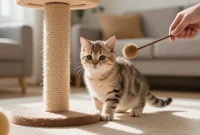
Choose the Right Tools: Use a high-quality wand toy (like a Da Bird or a Cat Dancer) that lets you control the movement of a feather or felt piece across the room.
-
Emulate Real Prey Behavior: Do not wave the toy directly in your cat’s face; real prey runs away from a predator. Make the feather move along the floor, duck behind doorways, hop over cardboard boxes, and hide behind chairs. Allow your cat to crouch, wiggle their hips, track the movement, and stalk the target silently.
-
The Scaling Intensity Peak: Start slow, building up your cat’s curiosity until they are sprinting, leaping into the air, and chasing the toy at full speed. Maintain this high-intensity cardio for 15 to 20 minutes.
-
The Wind-Down Mimicry: As the session nears its end, make the “prey” move slower and more erratically, as if it is getting tired. Finally, let your cat make one final leap, catch the toy securely in their paws, and bite down on it to signal a successful kill.
Step 2: The Post-Hunt Feed Feast
The moment your cat catches the toy and completes the “hunt,” walk straight to the kitchen and serve them their largest, most satisfying meal of the day.
-
The Macronutrient Shift: Opt for a high-protein, nutrient-dense wet food for this pre-bedtime meal. Wet food requires more effort to chew, provides excellent hydration, and floods their digestive tract with complex amino acids that naturally promote drowsiness.
-
Use Puzzle Feeders: If you feed your cat dry kibble, do not simply dump it into a standard bowl. Use a detailed puzzle feeder or a rolling treat ball. This forces your cat to use their paws and brain to extract each piece of food, combining physical eating with mental problem-solving to thoroughly drain their remaining energy reserves.
Step 3: The Natural Sedative (Groom and Sleep)
Once your cat finishes their meal, step back and let nature take its course. Backed by millions of years of evolutionary programming, your cat will immediately sit down, find a comfortable spot, and begin thoroughly washing their paws, face, and body.
This grooming ritual is deeply soothing for a cat, lowering their heart rate and triggering a powerful release of calming hormones. Within 15 to 20 minutes of finishing their food, their eyes will grow heavy, their body will relax, and they will drift into a deep, continuous 6-to-8-hour sleep cycle that aligns beautifully with your own night’s rest.
Environmental Enrichment and Automation Setups
While the Hunt-Eat-Groom-Sleep framework works wonders, managing a cat’s nighttime behavior also requires setting up your home environment to support healthy activity patterns throughout the day. By adding the right environmental enrichment and automated tools, you can keep your cat active and entertained while you are away, ensuring they don’t spend the entire day sleeping out of boredom.
                       THE DAYTIME STIMULATION ENGINE

  [ Window Perch + Bird Feeder ] ──► Continuous, Low-Stress Visual Simulation (Cat TV)
  [ Automatic Treat Dispenser ]  ──► Spontaneous Dopamine Triggers (Breaks Up Naps)
  [ Scent Enrichment Rotations ] ──► Olfactory Investigation Loops (Mental Fatigue)
1. The “Cat TV” Window Setup
Transform an ordinary window into a highly engaging, live entertainment hub for your cat. Install a sturdy, cushioned window perch that allows them to lounge comfortably with a clear view of the yard or street.
Directly outside that window, hang a clear plastic bird feeder or a suet cage packed with seeds. Within a few days, local birds, squirrels, and butterflies will start visiting regularly.
This provides your cat with hours of safe, low-stress visual stimulation—allowing them to watch animals move, track flying targets, and chatter their jaws in excitement. This passive mental engagement burns a surprising amount of cognitive energy, helping to keep them awake and active during the day.
2. Scent Enrichment Rotations
A cat’s sense of smell is roughly 14 times stronger than a human’s. You can easily lean into this powerful sensory pathway by introducing unique olfactory enrichment experiences throughout your home:
-
Cat Grass Pots: Place small pots of fresh wheatgrass or oat grass around the living room for your cat to sniff, chew on, and investigate.
-
The Exotic Herb Rotation: Twice a week, sprinkle a pinch of organic silver vine, valerian root, or high-grade catnip onto a specific cardboard scratcher.
-
Cardboard Box Safaris: Bring home empty cardboard shipping boxes from work, drop a few dried leaves or twigs inside them, and let your cat spend an hour sniffing and exploring these new, unfamiliar outdoor scents.
3. Automated Puzzle Feeders and Timed Dispensers
If you work long hours away from home, automated pet technology can be a lifesaver for breaking up your cat’s daytime nap loops. Invest in a reliable, programmable automatic feeder equipped with multiple meal slots.
Set the timer to drop a very small portion of kibble (just 10-15 grains) every three hours while you are away.
                  THE AUTOMATED DAYTIME INTERRUPT MATRIX

  09:00 AM ──► Workday Starts / Cat Naps
  12:00 PM ──► Slot 1 Drops ──► Cat Wakes Up, Hunts Kibble, Explores [30 Mins Active]
  03:00 PM ──► Slot 2 Drops ──► Cat Wakes Up, Tracks Scent, Plays    [30 Mins Active]
The sudden, mechanical sound of the feeder opening instantly wakes your cat up from their nap, breaking up their day-long sleep cycle. They have to get up, walk across the house, forage for the food, and solve the puzzle feeder to get their snack—ensuring they spend chunks of their afternoon active and engaged rather than saving all their energy for midnight.
Advanced Tactical Troubleshooting—Managing Multiple Cats and Multi-Tier Environments
If you live in a multi-cat household, managing night zoomies requires looking beyond individual behavior and evaluating social dynamics and territorial layouts. When multiple cats share a space, a late-night burst of energy from one cat can easily trigger a domino effect, turning a simple solo sprint into a chaotic, multi-cat wrestling match that echoes through the entire house.
                    THE MULTI-CAT RESOURCE EQUILIBRIUM

  [ Vertical Cat Trees ] + [ Wall Shelves ] ──► Expand Territory / Prevent Path Blockages
  [ Separate Food Stations ]                ──► Eliminate Guarding & Resource Anxiety
  [ Multiple Litter Boxes ]                 ──► Reduce Nighttime Ambush Stress Points
Vertical Space Optimization: Expanding the Feline Footprint
Cats view territory in three dimensions. While humans look at a room’s square footage across the floor, a cat evaluates a home by its accessible height layers. If your cats are constantly running into each other, blocking hallways, or getting into squabbles at night, it is usually because their environment lacks proper vertical territory.
By adding tall cat trees, wall-mounted climbing shelves, and cozy window hammocks, you instantly create a multi-level highway system through your home.
This vertical expansion allows an active cat to sprint up and over a sleeping companion without waking them up or violating their personal space. It diffuses social tension, gives timid cats a safe path to travel above the floor, and lets high-energy cats sprint vertically—burning twice as many calories per lap and tiring them out much faster.
Resource Isolation Matrix: Preventing Nighttime Confrontations
In multi-cat homes, middle-of-the-night chaos often stems from subtle resource guarding and territory disputes. If your food bowls, water fountains, and litter boxes are all grouped together in a single room, you are creating a high-stress bottleneck. An active cat pacing the house at night can easily corner a companion trying to use the litter box, leading to defensive hissing, chasing, and loud fights.
To keep the peace, distribute your essential cat resources evenly throughout the house using the $N+1$ Rule (where $N$ represents the total number of cats in your home):
By spreading these resources across different rooms, you eliminate competitive bottlenecks. A cat can easily eat, drink, or use the litter box in quiet isolation at 3:00 AM without stepping on another cat’s territory, keeping your nights peaceful and free of territory disputes.
Calming Ambient Environments: Soundscapes and Pheromones
For anxious cats or multi-cat homes dealing with minor social tension, you can use specialized ambient tools to lower stress levels when the house goes dark:
-
Synthetic Feline Pheromones: Plug a Feliway Optimum diffuser into the hallway or bedroom where your cats spend most of their time. These devices emit an odorless copy of natural feline facial pheromones, signaling to your cat’s brain that their environment is perfectly safe and secure, which naturally lowers nighttime pacing and stress-induced running.
-
Feline Acoustic Therapy: If your cat is frequently startled by outdoor city noises like garbage trucks, slamming doors, or passing sirens, use sound masking to protect their sleep. Play a soft looping track of white noise, ambient classical music, or specialized feline music (which incorporates calming purr rhythms and high-frequency tones) in the living room. This creates a soothing sound barrier that keeps external noises from waking your cat and triggering an adrenaline-fueled midnight sprint.
The Clinical Threshold When Night Zoomies Require Veterinary Intervention
While the vast majority of night zoomie cases can be completely resolved with behavioral modification, environmental enrichment, and play scheduling, there are times when nighttime restlessness crosses the line from a normal quirk into a serious medical red flag.
As a responsible pet parent, you need to know exactly how to recognize this clinical threshold.
                     VETERINARIAN CONSULTATION MATRIX

  [ MONITOR FOR RED FLAGS ]
  • Age Over 10 Years + Loud Continuous Night Howling (Vocalization)
  • Sudden, Unexplained Weight Loss Despite Chronic Over-Eating
  • Back Skin Rippling + Self-Mutilation / Tail Biting Francy
  • Lethargy During the Day Coupled with Deep Agitation at Night
                        │
                        ▼
  [ IF PRESENT: Schedule Full Blood Panel + Urinalysis Test Immediately ]
When to Book an Emergency Appointment
If your cat displays any of the following symptoms alongside their nighttime activity, skip the play sessions and schedule a comprehensive veterinary checkup immediately:
-
Sudden Onset in Senior Years: A calm, 12-year-old cat who has slept through the night for a decade suddenly starts sprinting frantically and crying out in the dark. This is a classic sign of Cognitive Dysfunction Syndrome or rising blood pressure.
-
Unexplained Weight Loss and Insatiable Hunger: Your cat is running around like crazy, eating double their normal food portions, but their spine and hip bones are becoming increasingly prominent. This pattern strongly points to Feline Hyperthyroidism.
-
Skin Rippling and Self-Mutilation: During a zoomie episode, your cat’s back skin twitches violently, and they turn to bite or chew their own tail or lower back so fiercely that they draw blood or lose fur. This intense reaction indicates Feline Hyperesthesia Syndrome or a severe neurological issue.
-
Altered Litter Box Habits: Your cat runs frantically out of the litter box, vocalizing loudly or straining to urinate. This is a medical emergency that often points to a painful Urinary Tract Infection (UTI) or a life-threatening urethral blockage, not a simple case of the playful zoomies.
Preparing for Your Vet Visit
When you take your cat to the clinic, bring along a detailed breakdown of their symptoms to help your vet make an accurate diagnosis:
-
High-Definition Video Records: Use your smartphone to capture clear footage of your cat’s nighttime behavior. Show the exact way they run, the sound of their meows, and their body language right before an episode starts.
-
A Timeline of Behavior Changes: Note exactly when the night zoomies began, how long each episode lasts, and any changes in their daily eating, drinking, or litter box habits.
-
Request a Complete Lab Panel: Ask your veterinarian to run a full diagnostic panel, including a complete blood count (CBC), a chemistry profile, a urinalysis, and a Total $T_4$ hormone test to screen for thyroid issues.
If an underlying medical issue is discovered, your vet can prescribe targeted treatments—such as daily methimazole for hyperthyroidism, joint supplements like Solensia for arthritis pain, or specialized neurological medications. By treating the underlying medical cause, you can restore your cat’s health and finally get a quiet, restful night’s sleep.
Conclusion: Achieving Feline and Human Harmony
Living with a cat is a beautiful exercise in cross-species communication, compromise, and mutual respect. When your cat runs through the house at midnight, they aren’t trying to break your spirit or intentionally disrupt your sleep. They are simply living out their ancient evolutionary programming, burning off a surplus of physical energy, or calling out for comfort the only way they know how.
By looking past the initial frustration of a 2:00 AM wake-up call, you can identify the root cause of their behavior and put a practical, lasting solution in place:
                     THE RESTFUL NIGHT CHECKLIST
  ┌────────────────────────────────────────────────────────────────────────┐
  │ 1. Run a 30-minute interactive hunt session every evening.              │
  ├────────────────────────────────────────────────────────────────────────┤
  │ 2. Feed a high-protein wet meal right before your bedtime.             │
  ├────────────────────────────────────────────────────────────────────────┤
  │ 3. Build vertical highways and separate multi-cat resources.           │
  ├────────────────────────────────────────────────────────────────────────┤
  │ 4. Completely ignore midnight attention-seeking behavior loops.        │
  └────────────────────────────────────────────────────────────────────────┘
Consistency is your secret weapon. If you stick to the Hunt-Eat-Groom-Sleep framework every single night, keep your home environment enriched during the day, and rule out any underlying medical issues with your vet, your cat’s internal clock will naturally adjust. The wild midnight sprints will fade into a thing of the past, and you can finally enjoy a deep, uninterrupted night’s sleep while your favorite feline snoozes peacefully right by your side.
FAQ: Why Do Cats Get the Zoomies at Night?
1. Why does my cat suddenly run around the house at night?
Cats often experience “zoomies” due to excess energy, natural hunting instincts, boredom during the day, or their crepuscular nature, which makes them most active around dawn and dusk.
2. Are nighttime zoomies normal for cats?
Yes. Occasional nighttime zoomies are completely normal and are usually a healthy way for cats to release pent-up energy and satisfy natural predatory behaviors.
3. At what age do cats have the most zoomies?
Kittens and young adult cats typically experience the most zoomies because they have higher energy levels and are still developing physically and mentally.
4. Why does my cat get the zoomies after using the litter box?
Some cats experience a burst of energy after eliminating waste due to relief, instinctive behavior, or stimulation of certain nerves around the digestive tract.
5. Can boredom cause nighttime zoomies?
Absolutely. Indoor cats that spend most of the day sleeping or lacking stimulation often save their energy for nighttime, leading to intense bursts of activity.
6. How can I stop my cat from waking me up at night?
Establish a consistent evening routine that includes interactive play, a substantial meal, and a calm environment before bedtime. The “hunt-eat-groom-sleep” routine is particularly effective.
7. Should I play with my cat before bed?
Yes. A 20–30 minute interactive play session before bedtime helps burn excess energy and encourages a longer sleep period afterward.
8. Do cats get the zoomies because they are nocturnal?
Not exactly. Cats are crepuscular, meaning they are naturally most active during dawn and dusk rather than throughout the entire night.
9. Can hunger trigger nighttime zoomies?
Yes. If your cat goes many hours without food, an empty stomach can trigger restlessness, foraging behavior, and increased nighttime activity.
10. Why does my cat meow loudly while running around at night?
Your cat may be seeking attention, responding to outdoor noises, expressing excitement, or experiencing discomfort. Persistent nighttime vocalization in senior cats may require veterinary evaluation.
11. Are zoomies a sign that my cat is happy?
In many cases, yes. Zoomies can be a sign of excitement, playfulness, and healthy energy release. However, sudden behavioral changes should always be monitored.
12. Can medical problems cause nighttime zoomies?
Yes. Conditions such as hyperthyroidism, arthritis, cognitive dysfunction syndrome, urinary tract issues, and feline hyperesthesia syndrome can contribute to unusual nighttime behavior.
13. When should I worry about my cat’s nighttime activity?
Consult a veterinarian if zoomies are accompanied by weight loss, excessive thirst, constant vocalization, confusion, aggression, litter box problems, or sudden behavior changes in older cats.
14. Do indoor cats get more zoomies than outdoor cats?
Generally, yes. Indoor cats often have fewer opportunities to hunt, climb, and explore, making them more likely to accumulate excess energy.
15. What is the best way to reduce nighttime zoomies?
The most effective approach combines daily exercise, environmental enrichment, puzzle feeders, scheduled meals, interactive play before bed, and consistent routines.
16. Why does my cat stare at the wall before getting the zoomies?
Cats often enter a heightened state of focus before a FRAP (Frenetic Random Activity Period). They may be tracking tiny sounds, shadows, or simply preparing for a burst of energy.
17. Can multiple cats trigger each other’s zoomies?
Yes. One cat’s sudden sprint can easily encourage other cats in the household to join in, creating a chain reaction of chasing and play.
18. Do senior cats get zoomies?
Some do, but sudden nighttime hyperactivity in older cats may indicate an underlying medical condition and should be discussed with a veterinarian.
19. Will an automatic feeder help reduce nighttime zoomies?
It can. Timed feedings and small overnight meals may prevent hunger-related restlessness and help regulate your cat’s activity schedule.
20. Is it okay to ignore my cat when they demand attention at night?
Yes, in most cases. Consistently rewarding nighttime attention-seeking behavior can reinforce the habit. Focus on providing attention, play, and enrichment during the day instead.