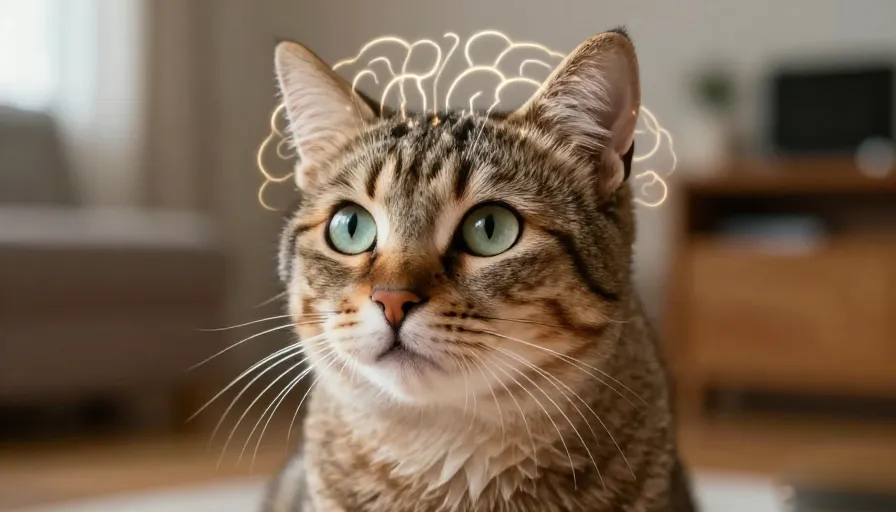
Have you ever caught your cat staring blankly at a wall, or gazing intently into your eyes, and wondered, “What is actually going on in that fluffy head?”
Cats have a long-standing reputation for being enigmatic, aloof, and completely self-reliant. For centuries, their mysterious behaviors have left pet parents guessing. However, veterinary science and feline behaviorists are finally pulling back the curtain on the feline brain.
According to research, cats think a great deal. While they do not process the world with the same existential complexity as humans, their highly developed brains are constantly calculating, problem-solving, and experiencing a rich spectrum of emotions.
Inside the Feline Brain Neuroanatomy vs. Intelligence
To understand what a cat thinks about, we first have to look at the physical architecture of their brain. The feline brain is a highly complex organ divided into specialized zones, with the cerebrum acting as the command center for thoughts, decision-making, and emotional processing.
                     THE FELINE BRAIN AT A GLANCE

  [ Physical Size ]   ──► ~5 cm (2 inches) long
  [ Weight Ratio ]    ──► Takes up 0.9% of body weight (Humans: 2%)
  [ Cortical Surface] ──► Folded and grooved to maximize cognitive processing power.
The Great Debate: Are Cats Smarter Than Dogs?
When it comes to measuring animal intelligence, scientists often look at the density of cortical neurons—the cells responsible for information processing, problem-solving, and thinking.
A notable 2016 study revealed a surprising statistic: cats possess roughly 300 million cortical neurons, whereas dogs have only about 160 million. While this data led some researchers to declare cats the intellectual victors, the scientific community remains divided. Dozens of studies utilizing different research techniques show conflicting results, meaning there is no definitive proof of which species is “smarter.”
What science does guarantee, however, is that the feline brain is fully equipped for complex, independent thought.
The Core Elements of Feline Thought
Because cats live firmly in the present moment, they don’t overthink their past choices or worry about the distant future. Instead, their daily thoughts are streamlined, functional, and driven by a mix of ancestral wild instincts and domestic adaptation.
Here are the primary things your cat is actually thinking about throughout the day:
1. The Strategy of Food Acquisition
In the wild, sourcing food is a full-time job. Even though domestic cats enjoy the luxury of served meals, their predatory hunting instincts remain incredibly sharp. They spend a significant amount of mental energy calculating when, where, and how food will appear.
                 FOOD ANTICIPATION AND RECOGNITION

  [ Auditory Cues ]     ──► Freezing at the sound of a pop-top can or rustling bag.
  [ Temporal Tracking ] ──► Hanging around the kitchen right before scheduled feeding times.
  [ Human Gestures ]    ──► Reading vocal tones and physical movements associated with meals.
Cats possess an excellent internal clock. If you consistently feed your cat at 5:00 PM, you will likely notice them pacing near their bowl or staring at you intently at 4:45 PM. Science shows that cats don’t just react to the smell of food; they actively predict it by tracking your daily routine, vocal tones, and physical gestures.
2. Humans (Spoiler: They Think You’re a Giant Cat)
One of the most fascinating revelations in feline behavior science comes from cat behaviorist John Bradshaw. His research indicates that cats do not realize humans are a completely different species.
                   HOW CATS VIEW AND TREAT HUMANS

  [ Rubbing Legs ]   ──► Scent-marking you as a safe member of their social group.
  [ Tail Upright ]   ──► Signaling comfort, respect, and friendly greeting.
  [ Mutual Grooming ]──► Treating you as an equal within their flexible hierarchy.
While cats recognize that we are significantly larger than them, they haven’t altered their evolutionary social behaviors to interact with us. When your cat rubs against your shins, lifts their tail vertically in the air, or licks your hand, they are treating you exactly how they would treat another cat they respect. They view you as an equal, a roommate, and a member of their trusted social circle.
3. Happiness and Loneliness
Cats absolutely process feelings of joy and sorrow. A happy cat is highly visible: their body is relaxed, they purr deeply, and they seek out your physical proximity. These moments of happiness are usually triggered by undivided human attention, interactive play, or a comfortable resting spot.
Conversely, cats experience genuine sadness and loneliness when their social and environmental needs are ignored. The common stereotype that cats are completely solitary animals that can be left alone indefinitely is a myth. They form deep emotional bonds with their humans and miss them when they are gone—which explains their intense, vocal greetings when you walk through the front door.
4. Fear and Stress Sensitivity
For a cat’s wild ancestors, fear was a vital mental mechanism required to stay alive. In a domestic home, a cat’s fear response is triggered by things they perceive as an immediate threat: a sudden loud noise, a forced trip inside a cat carrier, a veterinary examination, or conflict with another pet over territory.
                  CONSEQUENCES OF CHRONIC FEAR

  [ Behavioral Shifts ] ──► Avoiding social interaction, hiding, or hissing.
  [ Physical Ailments ] ──► Inappropriate urination outside the litter box.
  [ Compulsive Habits ] ──► Overgrooming patches of fur due to elevated cortisol.
Because cats are incredibly sensitive to changes in their environment, unaddressed fear can quickly manifest as behavioral or medical issues, including compulsive overgrooming or litter box avoidance.
Emotional Myths What Cats Don’t Think About
Because humans love anthropomorphizing their pets (projecting human emotions onto animals), we frequently misinterpret feline body language. Science proves that cats are completely incapable of experiencing certain complex, secondary human emotions.
                     THE EMOTION CONTRAST MATRIX

  [ Anger & Fear ] ──► YES ──► Driven by immediate action and survival instincts.
  [ Jealousy ]     ──► YES ──► Stemming from perceived resource scarcity.
  [ Guilt & Plots ]──► NO  ──► Felines live completely in the present moment.
The Myth of Guilt and Revenge
If you come home to find that your cat has knocked a glass off the counter or peed on the rug, and they are slinking away with lowered ears, it is easy to think, “They know exactly what they did wrong and they feel guilty.”
According to veterinary behaviorists, cats do not feel guilt, nor do they hold grudges or plot revenge.
Feline logic operates purely on immediate action and consequence. When a cat looks “guilty,” they are actually responding to your current negative body language, angry tone of voice, or tense energy. They aren’t thinking about what they did an hour ago; they are feeling fear and confusion regarding your sudden change in demeanor in the present moment.
Feline Jealousy A Battle for Vital Resources
While cats don’t experience guilt, they are entirely capable of feeling jealousy.
You have likely witnessed this firsthand if you are petting one cat and your second cat suddenly storms over, wedges themselves between your hand and their sibling, and demands attention. Jealousy can also flare up when a new baby arrives, a new partner moves in, or holiday visitors disrupt the household routine.
                       THE RESOURCE CHECKLIST

  [ Primary Resources ] ──► Food bowls, clean water stations, and litter boxes.
  [ Luxury Resources ]  ──► Elevated cat trees, sunny windows, and secure bedding.
  [ Social Resources ]  ──► Human interaction, affection, and physical play.
This jealous behavior stems from the way felines organize their social structures. Unlike dogs, who rely on a rigid pack hierarchy, cats operate on a flexible social system focused on resource management.
In a multi-cat home, cats co-exist by taking turns “owning” specific valuable assets throughout the day—whether that asset is the highest perch on the cat tree, a favorite scratching post, or your lap. When a cat thinks a vital resource is being permanently monopolized by another individual, jealousy kicks in, prompting them to assert themselves to reclaim what they view as essential to their security.
Summary Matrix: Understanding Feline Thoughts
| What They Are Thinking About | Scientific Reality | How It Manifests in Daily Behavior |
| Food & Hunting | High Priority | Pacing, vocalizing before mealtimes, tracking kitchen sounds. |
| Human Companions | View you as a massive, equal cat | Leg rubbing, headbutting (bunting), tail-up greetings. |
| Fear & Danger | High Sensitivity | Hiding, hissing, dilated pupils, running away from loud sounds. |
| Jealousy | Driven by a desire for resources | Interrupted play, crowding out other pets for your attention. |
| Guilt & Retaliation | Non-Existent | Live purely in the moment; they react to your anger, not past actions. |
By recognizing that your cat lives entirely in the present, experiences deep affection for you as an equal, and views their environment through the lens of resource security, you can decode their behavior with clarity. Dropping human expectations of “guilt” or “revenge” allows you to address their fears directly, ultimately building a much stronger, happier bond with your feline family member.
FAQ
1. Do cats actually think about things like humans do?
Cats think constantly, but not in the same way humans do. Their thoughts focus on survival, food, safety, social bonds, territory, and daily routines rather than abstract concepts or long-term planning.
2. What do cats think about most during the day?
Cats primarily think about food, their environment, potential threats, comfortable resting places, play opportunities, and interactions with trusted humans and other animals.
3. Do cats recognize their owners?
Yes. Cats recognize their owners through scent, voice, appearance, and daily routines. They often view humans as trusted social companions rather than completely different species.
4. Why does my cat stare at me?
Cats stare for many reasons, including curiosity, affection, anticipation of food, communication, or simply observing your behavior. A relaxed stare with slow blinking is often a sign of trust.
5. Do cats miss their owners when they’re away?
Yes. Research and behavioral observations show that many cats form strong emotional bonds with their owners and can experience loneliness or stress when left alone for extended periods.
6. Can cats feel happiness?
Absolutely. Happy cats often purr, knead, slow blink, play, groom themselves regularly, and seek physical contact with trusted people.
7. Do cats feel jealousy?
Yes. Cats can display jealousy when they believe another pet or person is receiving attention, resources, or affection that they value.
8. Do cats feel guilt after doing something wrong?
No. Cats do not experience guilt in the human sense. What appears to be a guilty expression is usually a reaction to your tone of voice, posture, or emotional state.
9. Can cats hold grudges or plan revenge?
There is no scientific evidence that cats plan revenge. Problem behaviors are typically linked to stress, fear, anxiety, territorial issues, or medical conditions.
10. Are cats smarter than dogs?
The answer remains debated. Some studies suggest cats have more cortical neurons than dogs, but intelligence is complex and difficult to measure across species.
11. Why do cats rub against people’s legs?
This behavior is called scent marking. Cats use facial glands to leave their scent on people and objects they consider safe and familiar.
12. What causes fear and stress in cats?
Common triggers include loud noises, unfamiliar visitors, moving homes, vet visits, new pets, changes in routine, and competition for resources.
13. Do cats understand their names?
Most cats can learn and recognize their names, especially when the name is consistently associated with food, attention, or positive experiences.
14. Why does my cat follow me everywhere?
Following behavior often indicates trust, curiosity, companionship, or anticipation of food, play, or attention.
15. How can I better understand my cat’s thoughts?
Observe body language, tail position, ear movements, vocalizations, daily habits, and environmental preferences. Understanding these signals helps decode what your cat is feeling and thinking.