The decision to welcome a kitten into your home is an exciting milestone. We picture a peaceful household filled with soft purrs, playful pounces, and gentle companionship. However, as you browse animal rescue websites, read adoption forms, or speak with foster carers, you will likely encounter a strict warning: “We do not adopt out single kittens. Beware of Single Kitten Syndrome.”
This warning can be deeply discouraging for prospective pet parents. You might live in a small apartment that is perfect for one animal, or your household budget may only comfortably cover the high-quality food, preventative veterinary care, and insurance premiums for a single pet.
This policy leaves many asking important questions: Will adopting a single kitten truly guarantee a lonely, anxious, and destructive adult cat? Is “Single Kitten Syndrome” a scientifically proven medical condition, or is it a well-meaning myth passed down through animal shelters?
This comprehensive guide takes a look at the structural, behavioral, and developmental realities of raising young felines. Written with input from animal behaviorists, veterinary insights, and the latest research in ethology, this handbook bypasses common labels to explore the true mechanics of kitten development.
Whether you are trying to decide if you should adopt a pair of littermates, or you are looking for ways to raise a well-socialized, confident single kitten, this guide provides the practical strategies and behavioral steps you need to succeed.
Deconstructing “Single Kitten Syndrome” Science vs. Anecdote
To address feline behavior effectively, we must separate common cultural labels from established scientific facts. In the animal rescue community, Single Kitten Syndrome (sometimes referred to as Tarzan Syndrome) is widely treated as an absolute certainty.
The theory suggests that when a kitten is separated from its mother and littermates before the age of 12 weeks and raised alone, it misses out on critical social feedback. As a result, the kitten is thought to develop behavioral issues, including extreme boredom, separation anxiety, destructive chewing or scratching, litterbox avoidance, and unprovoked aggression toward human caretakers.
┌───────────────────────────────────────────────────────────────────────────┐
│              The Theoretical Single Kitten Syndrome Loop                  │
├───────────────────────────────────────────────────────────────────────────┤
│  Early Isolation ──► Missing Peer Feedback ──► Boredom & High Stress      │
│                                                      │                    │
│  Destructive Habits ◄── Biting & Scratching Humans ◄─┘                    │
└───────────────────────────────────────────────────────────────────────────┘
However, if you look into peer-reviewed veterinary science and clinical animal behavior research, you will find a surprising truth: There is no formal scientific evidence validating the existence of Single Kitten Syndrome as a distinct medical or psychological condition.
What the Research Tells Us
Clinical studies focusing on feline development show no direct correlation between a cat’s adult aggression levels and whether it was raised as a single kitten, bottle-fed by humans, or adopted early. Instead, research confirms that an adult cat’s behavioral health is shaped by three distinct factors:
-
Genetic Temperament: The inherited personality traits passed down from the parents.
-
Environmental Enrichment: The complexity, safety, and stimulation provided within the home environment.
-
Owner Training Frameworks: The consistency, positive reinforcement, and boundaries set by the human family.
Labeling every behavioral issue in a solo cat as a “syndrome” oversimplifies feline psychology. It ignores the fact that millions of single-household cats grow up to be perfectly social, affectionate, and emotionally balanced companions.
Aggression, destructive scratching, and inappropriate elimination are not automatic results of a solo adoption; they are clear signs of an under-stimulated environment, underlying medical discomfort, or unintentional reinforcement of bad habits by the owner.
The Core Risk Matrix — The Reality of Hand-Reared and Orphaned Singletons
While the sweeping claims of Single Kitten Syndrome lack scientific validation across all domestic cats, there is one specific group that genuinely faces high developmental risks: single kittens that are hand-reared by humans without an adult queen (mother cat) or siblings.
                       [ Feline Developmental Paths ]
                                     │
       ┌─────────────────────────────┴─────────────────────────────┐
       ▼                                                           ▼
 [ Reared by a Queen ]                                      [ Hand-Reared Solo ]
 ├── Learns clear boundaries                                ├── Misses feline body cues
 ├── Observes maternal behavior                             ├── Struggles with play limits
 └── Practices bite inhibition                              └── High risk for over-stimulation
The Missing Feline Feedback Loop
When a kitten is raised by a mother cat alongside a litter of siblings, it constantly receives natural behavioral feedback. If a kitten bites its mother too hard during nursing, the queen immediately corrects the behavior with a sharp vocalization or physical nudge. If a kitten uses its claws too aggressively while playing with a sibling, the sibling cries out and stops playing entirely.
A hand-reared single kitten misses out on this natural feedback loop. They do not have peers to teach them how to read physical boundaries or understand subtle social cues:
-
Misreading Social Cues: These cats often struggle to interpret the body language of other animals. They may fail to understand when a fellow pet is growling, hissing, or asking to be left alone, which can lead to conflict in multi-pet homes later in life.
-
Struggling with Play Limits: Because their early interactions were entirely with soft human hands or inanimate toys, they often do not understand that their sharp teeth and claws cause genuine pain.
-
Over-Stimulation Issues: Without a mother cat to teach them self-soothing techniques, these singletons can easily become over-stimulated during everyday interactions like petting, switching rapidly from relaxation to defensive biting.
🩺 Clinical Best Practice for Rescued Singletons
If you rescue an orphaned kitten under eight weeks old, the ideal approach is to introduce them to a lactating foster mother cat if possible. If a foster queen is unavailable, look for opportunities to safely pair the singleton with an orphaned litter of a similar age. This ensures they receive the vital species-specific education that no human caregiver can replicate.
Sibling Dynamics and the Truth About “Littermate Syndrome”
To make an informed choice for your home, it is equally important to look at the behavior of kittens raised in pairs. Many animal shelters recommend adopting two siblings together to ensure a smooth transition. However, this raises another question: do cats suffer from the same “littermate syndrome” observed in dogs?
In canine behavior, Littermate Syndrome describes an unhealthy, codependent bond that can form between two puppies from the same litter. This deep bond can cause severe separation anxiety, fear of outsiders, and extreme panic if the two dogs are separated for even a short period.
┌───────────────────────────────────────────────────────────────────────────┐
│                     Canine vs. Feline Sibling Bonds                       │
├───────────────────────────────────────────────────────────────────────────┤
│  • Canines: High risk for unhealthy codependency, separation panic, and   │
│    stunted socialization with outsiders (True Littermate Syndrome).       │
│  • Felines: Form deep early bonds via social play, but maintain their      │
│    individual identity. No clinical risk of psychological codependency.  │
└───────────────────────────────────────────────────────────────────────────┘
Fortunately, clinical littermate syndrome does not occur in felines. While sibling kittens form deep bonds through shared grooming, sleeping, and playing, they maintain their individual identity and do not experience structural psychological damage when separated as adults.
The Evolution of the Sibling Bond
Between the ages of 4 and 12 weeks, a kitten’s brain is highly focused on social play and predatory behavior. Sibling pairings use this window to practice essential survival skills:
[ Mock Pouncing & Chasing ] ──► Eye-Paw Coordination ──► Successful Predatory Drive
By pouncing, batting, and chasing one another, siblings develop excellent eye-paw coordination and learn how to track fast-moving objects. These activities serve as low-risk practice runs for their natural hunting instincts.
However, a sibling bond is not guaranteed to last forever. This is often a surprise to new owners: sibling cats do not always maintain a close relationship as adults.
When cats reach social maturity—typically between 2 and 4 years of age—their adult personalities lock in. At this stage, related cats may naturally drift apart. They might transition from close friends to distant housemates, or even display territorial behavior if their individual tolerance limits for space and resources change.
The 6-Step Socialization Protocol for Single Kittens
If you choose to adopt a single kitten, or if you already have a solo cat at home, you do not need to worry about behavioral issues as long as you take an active role in their development. The prime window for early feline socialization sits between 2 and 7 weeks of age, but a kitten’s ability to learn and adapt continues well past this early phase.
By implementing this structured, human-led socialization protocol, you can provide the boundaries, environmental variety, and life skills your single kitten needs to grow into a calm, confident, and resilient adult cat.
                      [ The Solo Kitten Socialization Loop ]
                                        │
     ┌──────────────────────────────────┼──────────────────────────────────┐
     ▼                                  ▼                                  ▼
[ Touch Association ]         [ Social Referencing ]             [ Audible Habituation ]
├── Voluntary Contact         ├── Multi-Texture Footings         ├── Gradual Noise Exposure
└── Positive Rewards          └── Safe Object Auditing           └── Low-Volume Calibration
Step 1: Create a Positive Association with Human Handling
To prevent your kitten from developing defensive or fear-based aggression, you must teach them that human touch is always safe and rewarding.
-
Avoid Forced Contact: Never reach into a hiding spot to pull a tense kitten out, and avoid picking them up against their will. This can trigger their natural defense mechanisms and break their trust in you.
-
Encourage Voluntary Interaction: Sit quietly on the floor and let the kitten approach you out of curiosity. Use low-value food rewards or interactive toys to encourage them to step onto your lap.
-
Desensitization Work: If your kitten displays tension or fear around touch, start a gradual desensitization routine. Touch them gently on a low-stress area (like the base of the chin) for just a brief moment, then immediately offer a high-value treat. Over several weeks, slowly expand this handling to include their paws, ears, and belly, preparing them for easy vet exams and grooming sessions later in life.
Step 2: Introduce Diverse Environments and Social Referencing
A cat that is kept entirely isolated in a single, quiet room during its early development can grow up to be nervous and easily startled by minor changes around the home. You can prevent this through a process called Social Referencing.
[ New Object / Texture ] ──► Reassuring Human Guidance ──► Confident Exploration
Give your kitten a wide variety of safe, unusual objects and surfaces to explore under your supervision:
-
Texture Variety: Encourage your kitten to walk across different household surfaces, such as hardwood floors, thick carpets, smooth tiles, plastic mats, and crinkly packing paper.
-
Novel Objects: Place safe, oddly shaped items in their living space for them to inspect, such as empty cardboard boxes, open travel carriers, plastic laundry baskets, and large paper bags (with the handles removed to avoid entrapment).
-
Rewarding Curiosity: Whenever your kitten walks up to a new object to sniff it, praise them warmly or drop a piece of kibble nearby, teaching them that exploring new things leads to positive outcomes.
Step 3: Build Familiarity with Normal Household Noises
Because cats have incredibly sensitive hearing, sudden loud noises can easily trigger a fight-or-flight response. You can help your kitten build confidence around everyday sounds by using a systematic habituation program.
Low-Volume Background Tracks ──► Neutral Response ──► Real-World Appliance Testing
-
Audio Training: Play recorded audio tracks of common household noises—such as ringing doorbells, barking dogs, crying babies, vacuum cleaners, and loud thunder—at a very low volume while your kitten is eating or playing.
-
Gradual Volume Adjustments: As long as your kitten remains calm and relaxed, slowly turn up the volume of these audio tracks over several days.
-
Real-World Application: Once the kitten ignores the recorded audio, begin running your actual household appliances (like a blender, hair dryer, or washing machine) at a distance while a family member feeds the kitten premium wet food. This teaches them to associate loud, real-world sounds with delicious rewards.
Step 4: Organize Positive Interactions with Visitors
To ensure your kitten does not grow up to be fearful or defensive around house guests, you should introduce them to a diverse variety of people during their early months.
[ Guest Introduction ] ──► Calm Posture & Low Angle ──► High-Value Reward Delivery
-
Diverse Introductions: Invite friends and family members of different ages, genders, and heights to meet your kitten.
-
Control the Interaction: Instruct your guests to sit quietly on the floor, avoid making direct, prolonged eye contact (which cats interpret as a threat), and let the kitten approach them first.
-
Guest-Delivered Rewards: Provide your visitors with your kitten’s favorite treats or an interactive wand toy. This teaches the kitten to view new people as a fun source of play and food, rather than a potential danger.
Step 5: Conduct Safe, Supervised Interspecies Introductions
If there is a chance your kitten will share a home with other animal species in the future—such as dogs, birds, or small pocket pets—you should carefully introduce these animals while the kitten is young.
[ Scent Swapping via Cloth ] ──► Distant Visual Contact ──► Controlled Leashed Meeting
-
Scent Swapping: Before bringing the animals into the same room, rub a soft cloth over the other pet (such as a friendly family dog) and place it in the kitten’s environment. This lets the kitten inspect the animal’s scent in a completely stress-free way.
-
Controlled Sightlines: Organize their first physical meeting across a secure barrier, like a mesh screen or a glass door.
-
Leashed Introductions: Move the animals into the same space only if the dog is fully trained, calm, and secured on a short leash and harness. Keep the initial meetings brief, reward both animals for calm behavior, and end the session immediately if either pet shows signs of stress or fear.
Step 6: Establish Boundaries and Healthy Play Habits
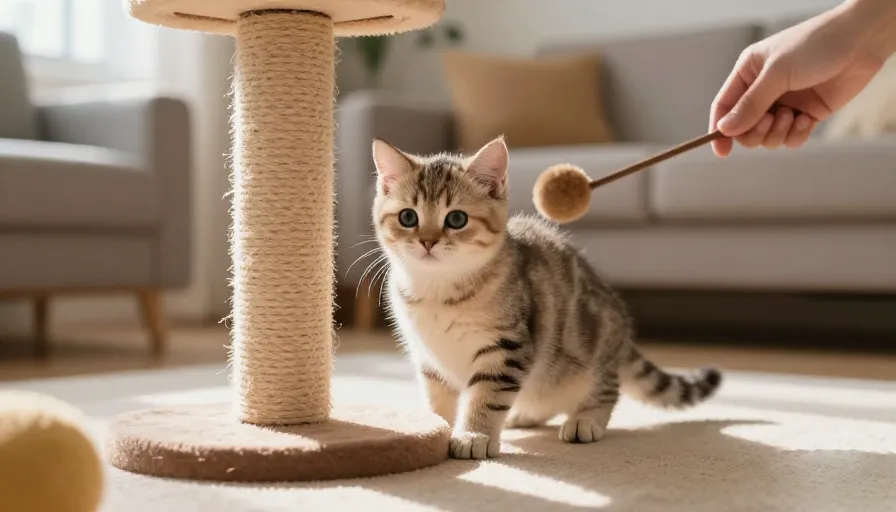
The most common mistake single kitten owners make is using their bare fingers, toes, or hands to play with the kitten. While a tiny kitten pouncing on your moving fingers might look adorable, you are accidentally training them to view human skin as a valid target for biting and scratching.
[ Wiggling Human Fingers ] ──► Accidental Prey Target ──► Adult Aggression Habits
As the cat grows older, stronger, and develops adult teeth, this learned play behavior turns into painful, unprovoked aggression.
┌───────────────────────────────────────────────────────────────────────────┐
│                     The Right Way to Play with a Kitten                   │
├───────────────────────────────────────────────────────────────────────────┤
│  • Dangerous Approach: Using hands or feet as targets. Teaches the cat   │
│    that biting human skin is an acceptable part of play.                  │
│  • Correct Approach: Redirect all play onto interactive wand toys, felt │
│    mice, or kickers. Keeps human skin completely out of the equation.     │
└───────────────────────────────────────────────────────────────────────────┘
-
Redirect Play Intently: From day one, keep a clear boundary between human skin and play items. Redirect your kitten’s energy onto appropriate toys, such as lightweight ping pong balls, crinkly paper toys, catnip-stuffed mice, and long fishing pole wand toys.
-
Manage Biting Incidents: If your kitten accidentally bites your hand or scratches your ankle during a play session, freeze completely. Do not pull your hand away quickly (as this mimics fleeing prey and triggers their hunting instinct) and avoid yelling or hitting the kitten, which can cause long-term fear.
-
Use the Timeout Method: Simply say a calm, firm “No,” remove your hands, and walk out of the room for two minutes. This teaches the kitten that using teeth or claws on human skin causes all attention and fun to stop immediately.
Single Adoption vs. Sibling Pairings — A Strategic Decision Guide
Deciding whether to bring home a single kitten or a pair of siblings requires looking past emotional appeals and carefully evaluating your household resources, schedule, and living space. Both choices offer distinct paths and require different levels of commitment from the owner.
                        [ Adoption Path Evaluation ]
                                     │
       ┌─────────────────────────────┴─────────────────────────────┐
       ▼                                                           ▼
 [ The Solo Option ]                                        [ The Sibling Pair ]
 ├── Requires high human input                              ├── Higher financial investment
 ├── Fits predictable schedules                             ├── Builds built-in play habits
 └── Allows focused individual bonds                        └── Minimizes separation stress
The Solo Option: Pros and Cons
Adopting a single kitten allows you to build an intensely focused, one-on-one bond with your pet. Financially, it keeps your ongoing expenses predictable, as you only need to budget for a single set of vaccinations, one sterilization surgery, and single portions of premium food.
The main challenge is the time commitment: you must become your kitten’s primary playmate and social anchor. If you work long hours away from home, a single kitten can easily become bored and lonely, which can manifest as destructive behavior around the house.
The Sibling Pair: Pros and Cons
Adopting a pair of littermates is an excellent option for busy households. Sibling kittens keep each other entertained, expend energy naturally through mutual play, and provide constant companionship, which significantly reduces separation stress when you are away at work. They also teach each other bite inhibition naturally.
The primary trade-off is financial: your setup costs, ongoing food bills, veterinary care, and emergency insurance premiums double instantly. You must ensure your home can comfortably handle two adult cats, with enough space for multiple scratchers, climbing trees, and separate litterbox stations.
Critical Comparison Matrix: Single vs. Pair Adoptions
To help you choose the best configuration for your lifestyle, use this analytical matrix to compare the requirements and behavioral factors of raising a single kitten against a sibling pair:
Final Strategy Checklist for Prospective Owners
Before you finalize your adoption paperwork, use this comprehensive step-by-step checklist to verify that your home environment is ready to support your new kitten:
-
[ ] Audit Your Daily Schedule: Ensure you have the time to provide at least three 15-minute interactive play sessions every day if you are adopting a single kitten.
-
[ ] Review Your Veterinary Budget: Confirm that your finances can comfortably cover high-quality nutrition, unexpected emergency care, and monthly health insurance premiums (multiplied by two if adopting siblings).
-
[ ] Set Up a Secure Settle-In Room: Prepare a quiet, isolated space equipped with a litterbox, food station, scratching post, and safe hiding spots to help your new pet adjust smoothly during their first week.
-
[ ] Remove Toxic Houseplants and Hazards: Check that your home is completely free of dangerous plants (such as lilies), exposed electrical cords, loose string, and small swallowing hazards.
-
[ ] Establish a Litterbox Station Plan: Follow the veterinary standard rule of thumb for litterboxes: provide one box per cat, plus one extra (2 boxes for a single cat, 3 boxes for a pair), placed in quiet, distinct locations around the house.
-
[ ] Stock Up on Appropriate Toys: Invest in high-quality interactive wand toys, balls, and independent puzzle feeders to keep your kitten mentally stimulated, making sure to avoid using your bare hands for play.
Final Thoughts: Designing a Feline-Centric Home
Ultimately, the debate over Single Kitten Syndrome highlights a fundamental truth about feline care: every kitten is an individual shaped by its genetics, environment, and the guidance of its owner. There are no absolute, rigid rules in feline development. Some kittens thrive in a solo environment, preferring to focus all their attention on their human family, while others are happier sharing their lives with a sibling.
[ Genetic Foundation ] + [ Enriched Environment ] + [ Consistent Boundaries ] = A Balanced Cat
As a responsible owner, your job is to look past common behavioral labels and focus on meeting your kitten’s actual daily needs. By providing a rich, stimulating environment, setting clear behavioral boundaries through positive reinforcement, and dedicating time to early socialization, you can confidently navigate your pet’s development.
Whether you choose a solo companion or a pair of lifelong friends, taking an active, informed approach ensures your kittens will grow into calm, well-adjusted, and happy adult companions for years to come.
FAQ — Single Kitten Syndrome & Kitten Socialization
1. What is Single Kitten Syndrome?
Single Kitten Syndrome is a behavioral theory suggesting that kittens raised alone may develop issues like biting, boredom, or destructive behavior due to limited feline social interaction.
2. Is Single Kitten Syndrome scientifically proven?
No. There is currently no formal scientific evidence recognizing Single Kitten Syndrome as an official medical or psychological condition in cats.
3. Can a single kitten grow into a healthy adult cat?
Yes. With proper socialization, environmental enrichment, and consistent training, many single kittens become calm, affectionate, and emotionally balanced adult cats.
4. Why do shelters recommend adopting two kittens?
Shelters often recommend pairs because kittens naturally teach each other bite inhibition, social play skills, and provide companionship during long periods alone.
5. Are sibling kittens always better than a solo kitten?
Not always. Sibling pairs can reduce boredom and separation stress, but they also require more financial resources, space, and long-term care commitments.
6. What causes behavioral problems in kittens?
Most behavioral problems are linked to poor socialization, lack of stimulation, inconsistent boundaries, boredom, stress, or underlying medical issues.
7. How can I properly socialize a single kitten?
Use positive reinforcement, introduce safe new experiences gradually, encourage interactive play, expose them to normal household sounds, and avoid rough hand play.
8. At what age should kittens be separated from their mother?
Most veterinarians and behaviorists recommend kittens stay with their mother and littermates until at least 10 to 12 weeks of age.
9. Can single kittens become aggressive?
Any kitten can develop aggressive habits if play boundaries are unclear or if human hands are used as toys during play sessions.
10. Should I use my hands to play with my kitten?
No. Always use wand toys, balls, kickers, or plush toys to prevent the kitten from learning that biting human skin is acceptable.
11. What is the best way to stop kitten biting?
Immediately stop play, stay calm, redirect attention to toys, and briefly remove interaction when biting occurs.
12. Do cats experience littermate syndrome like dogs?
No. Cats can form strong sibling bonds, but they do not typically develop the severe psychological codependency commonly seen in dogs.
13. How much playtime does a single kitten need?
Single kittens usually need multiple interactive play sessions daily, ideally at least three sessions of 10–15 minutes each.
14. Are orphaned kittens at higher behavioral risk?
Yes. Hand-raised orphan kittens without feline companions may struggle more with social cues, bite control, and overstimulation.
15. What toys are best for single kittens?
Interactive wand toys, puzzle feeders, soft kicker toys, crinkle balls, and climbing structures help provide mental and physical stimulation.
16. Can kittens become lonely when left alone?
Yes. Kittens are highly social during development and may become bored or stressed if left alone for long periods without enrichment.
17. How many litter boxes should I have?
The standard recommendation is one litter box per cat plus one extra.
18. Is it okay to adopt only one kitten in a small apartment?
Yes. A small apartment can work very well if the kitten receives enough enrichment, playtime, climbing space, and social interaction.
19. How do I introduce my kitten to visitors?
Allow the kitten to approach guests voluntarily, avoid forced handling, and use treats or toys to create positive associations.
20. What is the most important factor in raising a balanced cat?
A combination of proper socialization, environmental enrichment, consistent boundaries, and patient human interaction is the key to raising a confident and healthy cat.