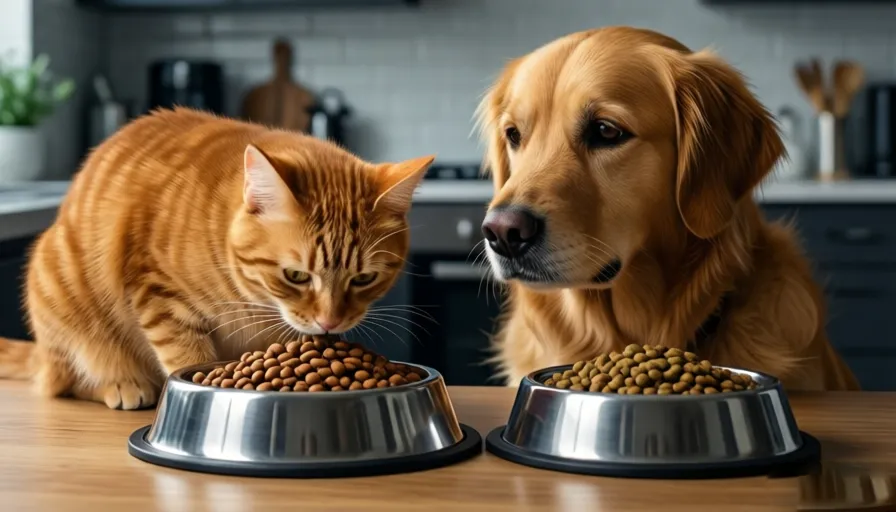
It is 7:00 PM in a multi-pet household. The dog is eagerly crunching away at a bowl of premium, organic kibble. Nearby, the resident feline slips quietly toward the dog’s bowl, nudges the golden retriever aside, and begins licking up the stray pieces of dog food. To many pet owners, this is a heartwarming display of domestic harmony. You might smile, snap a quick photo for social media, and think: “Food is food, right? At least they’re sharing.”
But behind this innocent scene lies a severe biological conflict. While a single instance of cross-feeding will not trigger an emergency room crisis, treating dog food as a regular meal for a cat is a slow, invisible path toward severe illness.
                     THE DOMESTIC CROSS-FEEDING ILLUSION
  ┌────────────────────────────────────────────────────────────────────────┐
  │ WHAT WE SEE      ──► A harmonious, multi-pet home sharing a meal.      │
  ├────────────────────────────────────────────────────────────────────────┤
  │ CLINICAL REALITY ──► A dangerous nutritional imbalance that slowly     │
  │                      starves vital feline organs of essential nutrients.│
  └────────────────────────────────────────────────────────────────────────┘
The pet food industry spends billions of dollars formulating kibble that looks, smells, and feels remarkably similar across species lines. However, the internal chemistry of these foods is entirely different. Kicking off this deep dive into veterinary nutrition, we must understand one fundamental truth: a cat is not a small dog.
This comprehensive guide breaks down the evolutionary, physiological, and biochemical differences between cats and dogs. We will analyze why chronic dog food consumption damages a cat’s body, evaluate the specific nutrient deficiencies that lead to blindness and heart failure, and provide real-world, human-tested strategies to keep your pets eating from their own bowls.
Evolutionary Biology The Obligate Carnivore vs. The Flexible Omnivore

To understand why dog food fails to meet a cat’s nutritional needs, we have to look thousands of years into the past at the evolutionary history of the wild ancestors of Felis catus and Canis lupus familiaris.
                  THE SPECIES EVOLUTIONARY DIVERGENCE

     [ Common Mammalian Ancestor ]
                 │
                 ├───────────────────────────────────────┐
                 ▼                                       ▼
    Order: Carnivora / Family: Felidae      Order: Carnivora / Family: Canidae
    Species: Felis catus (Domestic Cat)     Species: Canis familiaris (Domestic Dog)
    ───────────────────────────────────     ────────────────────────────────────────
    • Strict Obligate Carnivore             • Facultative Omnivore
    • Metabolic dependency on animal meat   • High metabolic adaptation to starches
1. The Cat: Nature’s Precision Predator
Cats belong to the family Felidae. Throughout their evolutionary history, felids have eaten a strict diet of prey—primarily small rodents, birds, reptiles, and insects. Because animal tissue is dense in pre-formed vitamins, amino acids, and fatty acids, the feline body gradually dropped the ability to synthesize these nutrients internally.
Why waste metabolic energy building complex enzymes to manufacture nutrients when those nutrients are already arriving pre-packaged in the meat of a fresh kill?
Consequently, cats are classified as obligate (or true) carnivores. This means they are biologically hardwired to get their nutrients from animal proteins and fats. Their bodies cannot adapt to plant-based diets, and their liver enzymes run on a continuous loop that burns protein for basic energy, regardless of how much carbohydrate is in their food.
2. The Dog: The Adaptive Scavenger
Dogs belong to the family Canidae. While their ancestor, the grey wolf, is primarily a hunter, canids evolved as highly adaptive scavengers. During their domestication alongside humans over the last 15,000 to 30,000 years, dogs adapted to eat the starch-heavy food scraps left behind by human agricultural societies.
Genomic research reveals that domestic dogs possess significantly more copies of the AMY2B gene (which codes for pancreatic amylase, the enzyme that digests starch) than wild wolves. This allows dogs to easily digest carbohydrates from grains, tubers, and vegetables.
As facultative omnivores, dogs can thrive on a wide variety of ingredients. Their bodies are fully capable of converting plant precursors into active vitamins and processing diets that are relatively low in protein and fat.
Anatomical and Gastrointestinal Profiling
The differences between cats and dogs are not just metabolic; they are deeply etched into their teeth, jaws, and the entire length of their digestive tracts.
                GASTROINTESTINAL ARCHITECTURE COMPARISON

  [ CAT: Short Gut Blueprint ]
  Stomach ──► Short Small Intestine ──► Tiny Cecum ──► Short Colon
  (Designed for rapid, high-efficiency digestion of highly bioavailable raw meat)

  [ DOG: Expansive Gut Blueprint ]
  Stomach ──► Elongated Small Intestine ──► Functional Cecum ──► Adaptable Colon
  (Designed to ferment fibers and extract nutrients from complex plant material)
1. Dentition and Jaw Mechanics
Look inside a cat’s mouth, and you will find an array of sharp, serrated teeth designed for one specific task: shearing meat and crushing small bones. Cats lack flat molars because they do not chew or grind plant matter. Their jaws move exclusively in a vertical, up-and-down motion, acting like a pair of biological scissors.
Dogs, by contrast, possess a mix of sharp carnassial teeth and flat, heavy molars. Their jaws have a small amount of lateral, side-to-side mobility, allowing them to crush berries, grind grains, and pulverize plant fibers before swallowing.
2. Intestinal Length and Fermentation Capacity
Because raw meat is highly digestible, cats have an incredibly short gastrointestinal tract relative to their body size. A short gut minimizes the time food spends in the body, which reduces the risk of bacterial overgrowth from raw meat.
Dogs possess a much longer small intestine and a functional cecum, providing the extra time and space needed to break down tough plant cell walls and ferment complex starches.
When a cat eats dog food—which is typically rich in plant-derived grains, fillers, and vegetable proteins—their short digestive tract struggles to process the material efficiently, frequently resulting in poor nutrient absorption, bloating, and loose stools.
The Fatal Five Critical Feline Nutrient Deficiencies Explained
If a cat is fed a diet consisting primarily of dog food over a period of months, their body begins to experience a series of dangerous biochemical shortages. Here are the five most critical nutrients that are missing from dog food in the quantities a cat requires:
                  THE FIVE FATAL NUTRIENT DEFICIENCIES
 ┌────────────────────────────────────────────────────────────────────────┐
 │ 1. TAURINE           ──► Causes blindness and dilated cardiomyopathy.   │
 ├────────────────────────────────────────────────────────────────────────┤
 │ 2. ARGININE          ──► Leads to hyperammonemia and neurological coma.│
 ├────────────────────────────────────────────────────────────────────────┐
 │ 3. PRE-FORMED VIT A  ──► Leads to severe vision and skin degeneration.  │
 ├────────────────────────────────────────────────────────────────────────┐
 │ 4. ARACHIDONIC ACID  ──► Causes skin scaling and clotting disorders.    │
 ├────────────────────────────────────────────────────────────────────────┐
 │ 5. TOTAL PROTEIN     ──► Leads to muscle wasting and immune failure.    │
 └────────────────────────────────────────────────────────────────────────┘
1. Taurine: The Heart and Vision Axis
Taurine is a beta-amino sulfonic acid that plays an essential role in stabilizing cell membranes, regulating calcium levels in the heart muscle, and supporting retinal function. Most mammals can synthesize taurine in the liver using two other amino acids: methionine and cysteine. Dogs do this with high efficiency, which is why dog food is rarely supplemented with high doses of external taurine.
Cats cannot synthesize taurine in significant amounts. To make matters worse, their bodies constantly lose taurine because their livers use it exclusively to conjugate bile acids for digestion. If a cat’s diet does not provide enough pre-formed taurine, their body is forced to draw from its own tissues, leading to two devastating clinical conditions:
-
Dilated Cardiomyopathy (DCM): The muscle walls of the heart thin and stretch, leaving the heart unable to pump blood effectively. This leads to congestive heart failure, fluid accumulation in the lungs, and sudden death.
-
Feline Central Retinal Degeneration (FCRD): Without taurine to protect the cells of the retina, the fotoreseptor layer slowly breaks down. This degeneration begins with no visible symptoms but progresses toward permanent, irreversible blindness.
2. Arginine: The Ammonia Detoxification Gateway
Arginine is an essential amino acid involved in the urea cycle—the metabolic pathway that converts toxic ammonia (a byproduct of protein breakdown) into harmless urea, which is then safely excreted in urine.
                      THE FELINE UREA CYCLE FAILURE
  [ Feline High-Protein Digestion ] ──► Generates massive ammonia byproducts
                                                │
                                                ▼
  [ Arginine Deficiency (Dog Food) ] ──► Disrupts the internal urea cycle
                                                │
                                                ▼
  [ Hyperammonemia Emergency ]       ──► Lethal ammonia buildup in brain
                                        (Causes seizures, coma, and death)
Because dogs have lower baseline protein needs, they can tolerate low-arginine diets without immediate harm. For a cat, however, even a single meal completely lacking in arginine can be a medical emergency.
Without arginine to keep the urea cycle running, ammonia rapidly builds up in the cat’s bloodstream (hyperammonemia). Within hours of eating, the cat may display severe neurological symptoms: vocalizing loudly, drooling excessively, stumbling, throwing up, and suffering from violent seizures that can lead to a fatal coma.
3. Pre-Formed Vitamin A (Retinol): The Carotenoid Wall
Vitamin A is a fat-soluble nutrient essential for maintaining healthy vision, skin barrier integrity, immune function, and cellular repair. Plants produce Vitamin A in a precursor form known as beta-karoten.
Anatomically equipped with the enzyme beta-carotene 15,15′-monooxygenase, dogs can easily split a molecule of beta-karoten apart in their intestines, turning it into active Vitamin A. Consequently, dog foods often use economical, plant-derived ingredients to satisfy their Vitamin A requirements.
Cats lack functional levels of this intestinal enzyme. They cannot convert beta-karoten into active Vitamin A, meaning they can starve in a sea of plant-derived nutrients.
                  VITAMIN A CONVERSION CAPABILITY

  [ DOG INSIDE THE GUT ]
  Beta-Carotene (Carrots/Plants) ──► [ Active Enzyme Split ] ──► Active Retinol (Used)

  [ CAT INSIDE THE GUT ]
  Beta-Carotene (Carrots/Plants) ──► [ Broken/Absent Pathway ] ──► Zero Retinol (Wasted)
Cats require pre-formed Vitamin A (retinol), which is naturally abundant in animal organs like liver. A cat raised on dog food will eventually run out of Vitamin A reserves, leading to severe night blindness, scaling skin, a dull coat, poor growth, and a compromised immune system.
4. Arachidonic Acid: The Essential Fatty Acid Missing Link
Fatty acids are the structural building blocks of cell membranes and act as precursors for hormones that regulate inflammation and immune responses. Linoleic acid (LA) is an omega-6 fatty acid found in abundance in grains and plant oils. Dogs can easily convert linoleic acid into arachidonic acid (AA) using desaturase and elongase enzymes in their liver.
Cats exhibit very low activity of these specific liver enzymes, preventing them from converting plant-derived oils into arachidonic acid. They must get their arachidonic acid directly from animal fats.
When a cat eats dog food that gets its fat content primarily from plant oils like corn oil or flaxseed oil, they quickly develop an arachidonic acid deficiency. This manifests as dry, flaky skin, reproductive failure, and a sluggish blood-clotting mechanism.
5. Crude Protein and Amino Acid Density
The baseline regulatory requirements set by the Association of American Feed Control Officials (AAFCO) reveal a clear gap in protein requirements between the two species:
While these percentages show the absolute minimums required to prevent obvious deficiency diseases, high-quality, biologically appropriate diets usually feature protein levels well above these baselines.
Because cats burn protein for basic energy at a high, continuous rate through constant liver enzyme activity, feeding them a standard dog food will quickly force their body into a negative nitrogen balance. To survive, the cat’s metabolism begins consuming its own muscle tissue to secure the amino acids needed for vital organ function, leading to muscle wasting (sarcopenia) and general weakness.
Comprehensive Comparison Matrix—Cat Food vs. Dog Food
To visually grasp the profound nutritional divide between these two dietary categories, let us analyze their composition across several biochemical parameters:
The Acute Toxicity Factor—When Dog Food Is Immediately Poisonous
While regular dog food acts as a slow drain on a cat’s health, there are specific types of dog food that pose an immediate, life-threatening danger to cats from a single meal.
                    THE MEDICATION CROSS-CONTAMINATION
  [ Grain-Free/Specialty Dog Foods ] ──► Enriched with therapeutic levels of copper
                                                  │
                                                  ▼
  [ Accidental Feline Ingestion ]    ──► Severe Feline Copper Storage Hepatopathy
                                        (Triggers liver necrosis and failures)
1. Prescription and Veterinary-Diet Dog Foods
Many dogs suffer from medical conditions that require specialized veterinary diets. For instance, a dog with chronic kidney disease may be prescribed an ultra-low-protein, low-phosphorus food. If a healthy cat eats this prescription diet, the severe lack of protein can trigger acute metabolic distress.
Conversely, grain-free dog foods often use high percentages of legumes, peas, and potatoes that are enriched with copper. While safe for dogs, these high copper concentrations can cause acute copper storage hepatopathy in cats, a toxic condition where copper builds up in the liver, leading to cell death and sudden liver failure.
2. Flavor Enhancers and Allium Additives
To make dog food highly appealing, mass-market manufacturers sometimes use powdered flavorings derived from the Allium family, such as garlic or onion powder. While the small amounts used may not harm a medium or large dog, cats are uniquely sensitive to these ingredients.
Compounds like thiosulfate found in onions and garlic cause oxidative damage to feline red blood cells. This leads to the formation of Heinz bodies, causing the red blood cells to rupture (hemolytic anemia). A cat suffering from this condition will exhibit pale or jaundiced gums, a rapid heart rate, dark brown urine, and profound weakness, requiring immediate emergency veterinary intervention.
Clinical Triage What to Do Based on Ingestion Metrics
If you catch your cat raiding the dog’s food bowl, your immediate response should be guided by two factors: how much they ate and how often it happens.
                      CLINICAL TRIAGE INTERVENTION ROADMAP
                                        │
         ┌──────────────────────────────┴──────────────────────────────┐
         ▼                                                             ▼
   [ SCENARIO A: Acute/Accidental ]                             [ SCENARIO B: Chronic/Long-Term ]
   • Volume: A few kibbles or one-off bowl.                     • Volume: Daily sneaking over months.
   • Action: Secure the bowl, monitor stool.                    • Action: Schedule immediate vet visit.
   • Risk: Low; transient digestive upset.                      • Diagnostic: Complete Blood, Serum Chemistry, Echo.
Scenario A: The Accidental Onetime Incident
Your cat managed to rip open a bag of dog food or cleared out a small bowl while you weren’t looking.
-
The Risk Level: Low. A single meal of dog food is not toxic enough to cause permanent organ damage or trigger acute nutrient deficiency.
-
Immediate Action Plan: Do not try to induce vomiting at home, as this can cause dangerous aspiration pneumonia. Simply remove the dog food, ensure your cat has plenty of fresh water, and monitor them for minor digestive issues like soft stools or mild vomiting over the next 24 hours. At the next feeding window, return them to their standard cat food.
Scenario B: Chronic Long-Term Ingestion
You discover that your cat has been sneaking dog food every day for months, or you have been intentionally feeding dog food to save money or simplify your feeding routine.
-
The Risk Level: High. Your cat is at significant risk for silent, progressive organ damage, particularly to their heart muscle and retinas.
-
Immediate Action Plan: Schedule an appointment with your veterinarian as soon as possible. Do not wait for visible symptoms to appear, as conditions like retinal degeneration and early-stage heart disease often develop silently.
Veterinary Diagnostic Protocol for Cross-Fed Felines
When you take your cat to the clinic for chronic dog food ingestion, your veterinarian will likely run several key diagnostic tests to evaluate their health:
-
Serum Biochemistry Profile: This test measures total circulating protein, albumin, and liver enzyme levels to evaluate systemic protein status and look for signs of muscle wasting or liver stress.
-
Complete Blood Count (CBC): Checks for red blood cell counts and inspects for Heinz bodies to rule out hemolytic anemia from potential onion or garlic exposure.
-
Blood Whole-Taurine Assays: A specialized blood test sent to an external lab to measure the exact taurine concentrations in the cat’s blood plasma and cells.
-
Echocardiogram (Cardiac Ultrasound): If the vet detects a heart murmur or irregular rhythm during the physical exam, an ultrasound allows them to visually inspect the heart walls and catch early signs of Dilated Cardiomyopathy before clinical heart failure sets in.
Practical In-Home Feeding Protocols for Multi-Pet Households
The easiest way to protect your cat from the dangers of cross-feeding is to design an environment that separates their eating spaces. Here are four practical, human-tested strategies to manage feeding in a multi-pet home:
In-Home Separation Tactics
  [ Strategy 1: Vertical ] ──► Mount feeding stations on high counters or wall shelves.
                                 │
                                 ▼
  [ Strategy 2: Temporal ] ──► Move from open 'free feeding' to structured 20-minute timed meals.
                                 │
                                 ▼
  [ Strategy 3: Physical ] ──► Install selective, microchip-activated pet bowls.
1. Leverage Vertical Space (The Feline Advantage)
Healthy cats are excellent climbers with fantastic vertical leaping abilities, whereas most dogs are firmly ground-dwelling scavengers. Use this natural edge to your advantage by moving your cat’s feeding station up high:
-
Place food bowls on top of a clean counter, a tall dresser, a sturdy refrigerator surface, or a dedicated wall-mounted cat shelf.
-
An added bonus: Eating high up makes cats feel safer and more relaxed, as they don’t have to worry about a larger dog hovering over their shoulder while they eat.
2. Transition from Free-Feeding to Timed Meals
Leaving food bowls sitting out on the floor all day (free-feeding) is an open invitation for cross-feeding. Instead, switch both your dog and cat to a disciplined, timed meal schedule:
-
Put the food bowls down two to three times a day for a strict 20-minute window.
-
Stay in the room to supervise the feeding window. Once the 20 minutes are up, pick up both bowls and store any leftovers securely in a closed pantry or cabinet. This approach completely eliminates the opportunity for late-night food swapping.
3. Use Microchip-Activated Automated Feeders
If you have a busy schedule that makes timed meals difficult, or if you have a slow-eating cat who likes to graze throughout the day, invest in a microchip-activated automatic pet feeder.
                       AUTOMATED ACCESS LOGIC FLOW
  [ Microchip Cat Approaches Feeder ] ──► [ RFID Sensor Reads Cat's Unique Chip ID ]
                                                       │
                                                       ▼
                                          [ Motorized Shield Retracts ]
                                         Feeder opens exclusively for the cat;
                                         snaps shut instantly if a dog approaches.
These smart feeders use an RFID scanner to read your cat’s existing identity microchip or a lightweight sensor tag worn on their collar. The motorized lid opens only when your registered cat approaches, and snaps shut immediately if it detects a dog trying to push its way in. This provides an absolute, foolproof barrier against food theft.
4. The Sanctuary Room Separation Method
If tech-focused solutions aren’t an option, simple physical barriers work just as well. Designate a specific room in your home—such as a laundry room, bathroom, or spare bedroom—as the “Cat Sanctuary Room.”
-
Install a secure pet gate across the doorway, propping it up just high enough off the floor so your cat can slip underneath while blocking your dog. Alternatively, use an adjustable door strap that keeps the door cracked just wide enough for a slender cat but too narrow for a wider dog.
-
Keep your cat’s food, water, and litter box inside this protected space, ensuring they can graze in peace with zero risk of canine interference.
Conclusion: Honoring Evolutionary Design for Lifetime Wellness
At first glance, dog food and cat food look almost identical, but their chemical formulations tell a very different story. The domestic cat is an incredibly refined predator—a masterclass in evolutionary specialization that relies completely on animal tissues to sustain its vital organs.
While a dog can happily adjust to a wide variety of foods, a cat’s metabolism is fixed and unyielding. Feeding dog food to a cat strips away the high-quality proteins, essential amino acids, and vital fats they need to survive, slowly damaging their vision, heart muscle, and structural health.
                    THE ULTIMATE PET HEALTH PARADIGM
  [ Formed Feline Diet ] ──► Protects heart elasticity, eye retinas, and lean muscle mass.
  [ Pure Canine Diet ]   ──► Supports omnivorous digestion and energy needs for the dog.
As pet owners, the most effective way to show our love for our companion animals is to respect their biological identities. By providing distinct eating spaces, using smart feeding tools, and ensuring your cat eats a diet tailored specifically to their needs, you protect their long-term health. This straightforward commitment keeps your cat thriving, energetic, and healthy by your side for years to come.
FAQ – Can Cats Eat Dog Food?
1. Can a cat eat dog food in an emergency?
Yes. If cat food is temporarily unavailable, a cat can eat a small amount of dog food for a day or two without serious harm. However, dog food should never replace a nutritionally complete cat diet for an extended period.
2. What happens if a cat eats dog food regularly?
Long-term consumption can lead to serious nutritional deficiencies, including low taurine, insufficient protein, inadequate vitamin A, and a lack of arachidonic acid. These deficiencies may contribute to heart disease, vision problems, muscle loss, and weakened immunity.
3. Why is dog food unsuitable for cats?
Cats are obligate carnivores and require higher levels of animal protein and specific nutrients that are naturally found in meat. Dog food is formulated for dogs, which can obtain nutrients from a wider variety of ingredients, including plant-based sources.
4. Is dog food toxic to cats?
Most standard dog foods are not immediately toxic to cats. The primary concern is nutritional inadequacy rather than poisoning. However, some specialty dog foods may contain ingredients or nutrient levels that are inappropriate for cats.
5. Can dog food cause blindness in cats?
Indirectly, yes. Chronic taurine deficiency caused by an inappropriate diet can lead to feline central retinal degeneration (FCRD), which may result in permanent vision loss.
6. Can dog food cause heart problems in cats?
Yes. Long-term taurine deficiency can contribute to dilated cardiomyopathy (DCM), a serious heart condition that affects the heart’s ability to pump blood effectively.
7. Why do cats seem to like dog food?
Many cats are attracted to the smell, texture, or novelty of dog food. Curiosity, competition with household pets, and food preferences may also encourage cats to eat from a dog’s bowl.
8. Is wet dog food safer than dry dog food for cats?
Neither is nutritionally complete for cats. While wet dog food may provide more moisture, it still lacks several essential nutrients that cats require.
9. How much dog food can a cat eat before it becomes dangerous?
A few pieces of kibble or an occasional meal generally isn’t a problem. Health risks arise when dog food becomes a regular or primary part of the cat’s diet over weeks or months.
10. What should I do if my cat accidentally ate dog food?
Monitor your cat for digestive upset such as vomiting or diarrhea, provide fresh water, and return to normal cat food at the next meal. Most healthy cats experience no lasting effects from a one-time incident.
11. How can I stop my cat from eating the dog’s food?
Feed pets in separate areas, use scheduled meal times, place the cat’s food in an elevated location, or use microchip-activated feeders that only open for the intended pet.
12. Can kittens eat dog food?
No. Kittens have even higher nutritional requirements than adult cats. Feeding dog food to a growing kitten can interfere with proper development and may lead to severe nutrient deficiencies.
13. What nutrients do cats need that dog food lacks?
The most critical nutrients include:
- Taurine
- Arginine
- Pre-formed Vitamin A (retinol)
- Arachidonic acid
- Higher levels of animal protein
14. Should I take my cat to the vet if it has been eating dog food for months?
Yes. A veterinary examination is recommended, especially if the cat has been regularly consuming dog food. Your veterinarian may suggest blood tests and a heart evaluation to identify potential nutritional deficiencies before symptoms become severe.
15. Can dogs eat cat food?
Occasionally, yes. Cat food is not toxic to dogs, but it is usually much higher in protein and fat than dogs need. Regular consumption can contribute to digestive upset, weight gain, and pancreatitis in some dogs.